Home
Our Team
Content
    Cover Story
    All Articles
    A Day in the Life
    Around Town
    Business Profile
    Get to Know Your Neighbor
    Good For You
    Green Page
    How They Met
    Lend a Hand
    Made in Vermont
    Meet your Neighbor
    Miscellaneous
    Spotlight on Our Sponsors
    Wisdom Stories
Advertise
Archives
Contact us

Quechee Times - Good people, good places and good things happening
  • Home
  • Our Team
  • Content
    • Cover Story
    • All Articles
    • A Day in the Life
    • Around Town
    • Business Profile
    • Get to Know Your Neighbor
    • Good For You
    • Green Page
    • How They Met
    • Lend a Hand
    • Made in Vermont
    • Meet your Neighbor
    • Miscellaneous
    • Spotlight on Our Sponsors
    • Wisdom Stories
  • Advertise
  • Archives
  • Contact us

Leap of Faith Summer Tradition or Risky Rite of Passage at Quechee Covered Bridge? September 16, 2026 READ MORE The Upper Valley in the Spotlight JAM’s Feature-Length Film Valley Transit September 16, 2026 READ MORE Visitor center trail sign Quechee Gorge Visitor Center Gets Ready for Summer June 21, 2026 READ MORE Ottauquechee School: Community Science Night
 June 21, 2026 READ MORE
All, Good For You

F.H. Clothing Company Steps Up for the Environment

May 19, 2025 by Cindy Heath No Comments

Quechee’s venerable F. H. Clothing Company owner, Joan Ecker, designed and produced her first “Fat Hats” 46 years ago on a human-powered treadle machine, selling them out of a wooden barrel at craft fair shows all over the Northeast. On one occasion, while selling in front of Lincoln Center, a New York Times reporter asked what else she made. Joan spied a passerby in a poncho – a popular garment at the time – and said “ponchos!” Soon after, while caring for her young children as a single mom, Joan made the proverbial leap into entrepreneurship and never looked back. Joan’s straightforward personality and ‘can-do’ attitude led to bartering with a builder friend willing to trade his carpentry skills to help construct her dream home for a “warm, fun hat” from her then sewing workshop, set up outside under a tarp. It’s this kind of collaborative thinking that has grown the F.H. Clothing Company into not only a successful clothing company, but also an environmentally conscious business that supports the local community.
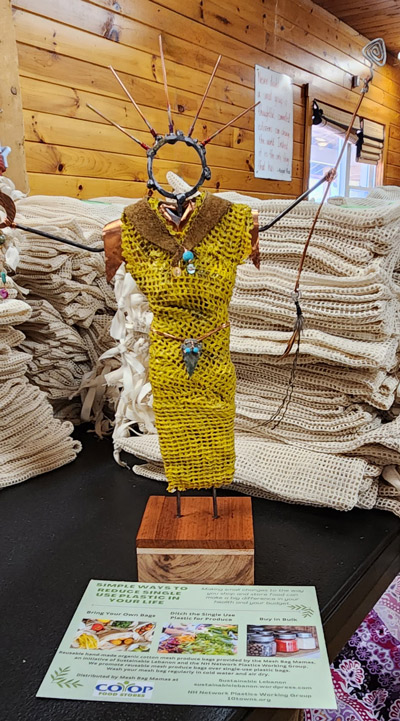
The Mesh Bag Mama mascot, created byCornish-based metal artist, Joanne Clifford

The Mesh Bag Mama mascot, created by Cornish-based metal
artist, Joanne Clifford

Joan runs “Fat Hat”, as it is fondly known locally, with her daughters Sara and Jenn, along with professional pattern maker, Lak Vorachek, and several sewers. Each season’s clothing designs are sewn in New York in a facility that is open, airy, comfortable, and with safe working conditions for the sewers. In addition to keeping the business humming along serving 130 boutique clothing stores across the country and the national catalog Artful Home, the trio has supported a number of community causes over the years. The Fat Hat team made masks to sell all over the country to keep the staff employed during COVID and donated free Fat Hats to cancer patients nationwide in honor of Joan’s mother.

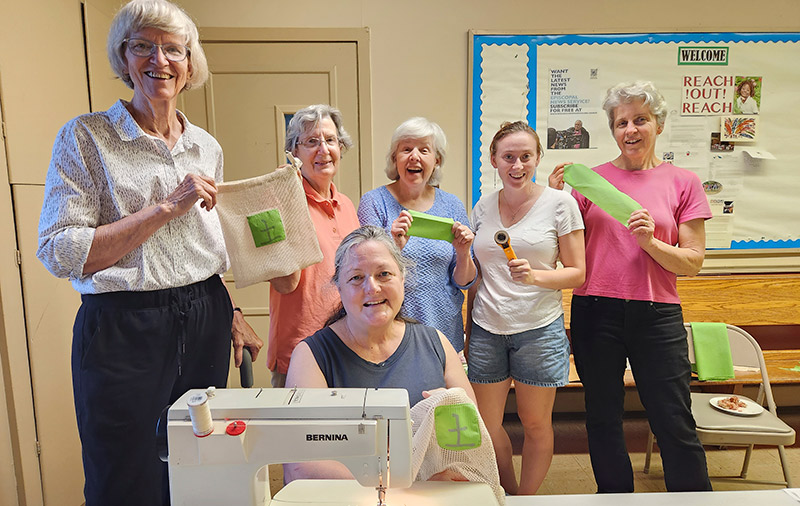
Most recently, Joan agreed to support the “Mesh Bag Mamas” project, an initiative of the NH Network Plastics Working Group. The project offers free, handmade reusable mesh bags to area grocery stores to encourage customers to ‘Ditch the Produce Plastic’ and reduce single-use plastic bag waste and pollution. The bags are made of washable organic cotton mesh decorated with the Japanese symbol for Earth, and they can transport fruits and vegetables home before they’re stored either in the refrigerator or on the counter top. Included with each bag is a postcard that outlines the hazards of single-use plastic and how to reduce its use to live a more sustainable lifestyle.

The Mesh Bag Mamas project began in 2023, with 30 volunteers from around the Upper Valley sewing 1,200 bags for distribution at area co-ops and grocery stores. Funding was provided by the Food Co-op, Sustainable Lebanon, Community Action Works, and private donations. NH songwriter, Mary Armstrong, wrote the “Mesh Bag Mama” song, which was performed at the Lebanon Co-op, and metal artist, Joanne Clifford, of Cornish created the Mesh Bag Mama mascot – a metal sculpture of a goddess wrapped in scraps of mesh. Fundraising efforts for supplies and labor for the project are ongoing by members of the Plastics Working Group, and the first round of 250 bags will be made available at the Woodstock Farmers Market this summer. Amelia Rappaport, a manager at the market, says the bag project aligns with the market’s sustainability efforts: “We love reusable bags, and would love for everyone to have them!”

Interestingly, Vermont has had a ban on single-use items in place since 2020, which includes plastic bags, but only covers bags distributed at the check out. The use of single-use plastic bags in grocery store produce and bulk departments is one of the exceptions to the law, so giving customers the choice for a reusable produce bag furthers the reduction of single-use plastic.
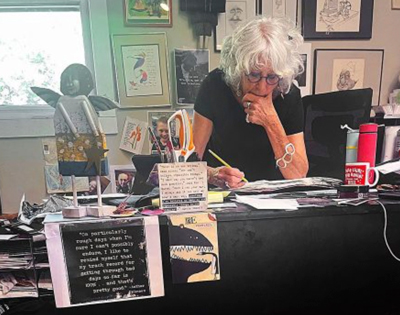
Joan Ecker, owner of F.H. Clothing Co. in Quechee

Joan Ecker, owner of F.H. Clothing Co. in Quechee

F.H. Clothing Company provides space for the cutting of the mesh bag material, and the bags are sewn at the home of one of Fat Hat’s part-time employees. Joan explains what inspired her to support the Mesh Bag Mamas project: “It’s always nice to participate in things that touch the community in some way. We’ve got to be concerned about the environment and continue to raise consciousness.” Joan foresees being able to continue to support the project around the company’s seasonal schedule, engaging other sewers as time goes along and demand for the bags increases.

Sara Ecker oversees the informal sustainability efforts for Fat Hat and notes several practices the company uses to try to reduce waste from purchasing goods to production, shipping garments to retailers, and store operations. “We try hard not to overbuy fabric or goods so we don’t have a lot of leftover yardage and garments, but this is also customer-driven. We donate clothing we don’t sell to Apparel Impact (a non-profit redistributing clothing to those in need) and to the Lyndonville Thrift Store during the recent floods because a lot of people lost their homes,” says Sara. “We also donate fabric, buttons, and other materials to area senior centers and afterschool programs.”

Fat Hat clothing is intentionally made to last, which is often not the case in the fashion industry. The company also uses recyclable bags for its shipping operations, and paper bags are used in the retail store. Jenn runs the retail store and even sources the ribbons used to wrap packages from a company that uses 100% compostable, water soluble material, non-toxic adhesives, and ink that is chlorine and acid free. You can leave the ribbon for the birds in your neighborhood or in the garden for safe nest building. Garment boxes are purchased from New England based company Packaging Specialties and are made of recycled material along with the bags, jewelry boxes, and small gift boxes. Both the ribbon company and Packaging Specialties offer carbon neutral shipping.

While many textile businesses and fashion designers come and go with the trends of the day, F.H. Clothing Company has stayed the course, developing a loyal customer following for its comfortable, sophisticated clothing lines, and its design mantra, “clothing that loves you just the way you are.” As a lifelong entrepreneur, Joan Ecker has perfected the art of continuous learning, decisiveness, curiosity, and willingness to experiment with new ideas.

From the first Fat Hats in New York to a thriving clothing business in Quechee, Joan describes the company’s evolution on her website. “After all these years, it strikes me that we’re not making and selling clothing at all…we’re selling our sense of humor, our independent Vermont lifestyle, and our comfortable attitude about dressing… clothing is just how we’ve packaged it!” F.H. Clothing Company is a great example of a business that can be successful, enduring, and make intentional choices to care for the planet.

For more information on the Mesh Bag Mama project, visit the Ten Towns Ten Actions website at 10towns.org.  

Share:
Reading time: 5 min
A Day in the Life

Finding Identity in Our Relationship to Nature

by Savannah Walczak No Comments

For as long she can remember, Alethea Bouton has always felt a strong connection to nature and wildlife conservation. She attributes this love and appreciation to her mother, Jennifer Bouton, who has always shared her own strong feelings to the intricacies of the nature around us. “Even things that seem very simplistic are actually very complicated, and there’s always something a little new to learn about behavior or how the different parts of ecology fit together,” Jennifer says. “It’s just beautiful and it’s interesting.” As Alethea and her mother were driving home one day, they passed the Vermont Institute of Natural Science (VINS), and Jennifer thought it would be the perfect place for Alethea to explore and deepen her interest in wildlife. On their first visit, they attended one of the VINS homeschooling programs, and they’ve been returning to VINS every year since Alethea was eight.

Alethea is currently enrolled in her first year at the Wildlife Science program at Paul Smith’s College, where she is studying fish and wildlife science. She has plans for a possible career path as a wildlife technician or conservation biologist. Alethea was able to explore these ambitions at VINS before attending college and honing in on her specific career interests. Alethea was most interested in the Baby Bird Feeder Program at VINS, after hearing a presentation about baby birds from a faculty member there. “He talked about the birds in a way that really made me feel like it was exciting,” Alethea says. “The excitement he had about how important they were inspired me.”

Alethea has been volunteering as a part of the Baby Bird Feeder Program at VINS every year since she was 12, and her mother Jennifer has joined her in volunteering over the years. On a weekly basis, their responsibilities include feeding different baby bird species every 15-30 minutes during a four hour period and administering solid foods with forceps, or liquid foods with a syringe for young birds or birds with a specific diet. VINS has given Alethea the opportunity to have hands-on experience with animals and information related to her future career, and has also provided her with leadership skills through her job as a camp counselor there in the summer.

Alethea and Jennifer also volunteer for a lights display that VINS hosts in the winter called “A Forest of Lights”, where they fill their landscape with light displays for visitors to walk through at night. There are towers, picture stations, and globes that the mother-daughter duo help manage, in addition to directing people through the displays, monitoring slippery areas, and helping with traffic control. Not only do these volunteer opportunities support VINS and their community, but they are also special moments shared between Jennifer and Alethea.

Alethea Bouton, holding a turtle

Alethea Bouton, holding a turtle

VINS hosts a summer program called “Nature Camp” for kindergarteners to eighth graders with different themes each week. Alethea began her journey as a Nature Camp instructor four years ago, and she plans to continue spending her summers there. Before becoming an instructor, VINS prepared Alethea with extensive training to accommodate all types of campers and possible situations. The training lasts about a week and includes first aid, CPR, basic safety training, what to bring on hikes, and preparation for extreme weather. They also prepare their instructors on how to handle interpersonal conflicts and misbehavior, help campers cope with their emotions, and how to re-engage campers with the group when they feel isolated. Alethea feels prepared every summer, she says: “[Our] approach [isn’t] just to corral the kids and make sure you don’t lose any, but also making sure that each camper is cared for and seen in a personal way. It’s confidence-inspiring to know all of this but to have also practiced it.” Alethea also applies the knowledge she’s acquired from her volunteer work at VINS to her work as a summer camp instructor. “I enjoy sharing what I know, not only the basic knowledge but also sharing fun facts about the stuff [they’re] learning about,” she says. This allows her to share her passion with youth and contribute positively to their summer camp experiences.

Growing up, Alethea has always been inspired by her mother’s connection and appreciation for nature as she’s always enjoyed being outside. “I’ve always just enjoyed being outside,” Jennifer reflects. “I’m a gardener. I don’t even care what I’m doing: It could be hiking, working in the compost pile, planting seeds, watching the bird feeder, it could be whatever.” Her mother’s love for nature, alongside the opportunity to volunteer and work at VINS, has led Alethea to define her own relationship with nature. “I feel closest to my faith when I’m outside and in nature,” Alethea says. “I feel a really important call to help to steward it and preserve it, because it’s something that’s really amazing and important to the whole planet.”

Share:
Reading time: 4 min
All, Cover Story

Running For the Greater Good: The Gift That Keeps on Giving

by Rose Terami No Comments

Registration is already sold out for the 33rd Covered Bridges Half Marathon (CBHM), happening on Sunday, June 1, 2025, but excitement continues to build as the summer nears on – and you can still get involved (continue reading to find out how and why you’ll want to!).

The 13.1 mile tri-town race, which begins at Saskadena Six Ski Area in South Pomfret and ends at the Quechee Polo Field, has donated over $2 million back to our local communities since 1992. And that’s really why it exists – to give back while having fun and enjoying the scenic routes that run through Pomfret, Woodstock, and Quechee.

Folks waiting to cheer on runners toward the fi nish line in front of Strong House Spa in Quechee

Folks waiting to cheer on runners toward the fi nish line in front
of Strong House Spa in Quechee

“We really give 95% of our income out to the community,” says CBHM race co-director, Mike Silverman. Funds are raised through race registration fees, runner pledges, and donations, which are funneled back into the community as donations to support the volunteer organizations whom the event wouldn’t be possible without – a symbiotic arrangement which has kept the Covered Bridge Half Marathon thriving for several decades.

“I really love how our three race communities support this race,” says race co-director, Nancy Nutile-McMenemy. “Pomfret, Woodstock, and Quechee really host this race; Mike and I just organize it.”

This year, over 2,500 runners signed up for the CBHM, coming from all over New England, with a few from Canada and as far as the West Coast. Runners span all ages – the youngest this year is 13 and the oldest runner is 81 years old.

Now a race co-director alongside Nancy, Mike first became involved with the Covered Bridges Half Marathon 25 years ago as a volunteer raising money on behalf of Vermont Adaptive – a nationally recognized organization that promotes inclusivity and independence through adaptive sports programs and activities.

Some of the shared race director responsibilities include managing registration, coordinating with volunteers, vendors, and race sponsors, verifying the course and traffic control, maintaining a website and social media, and staking out at the Quechee Polo Field on the day of the race to make sure everything runs smoothly. A CBHM board of directors and race committee also band together to support different aspects of the event – from finances to the finish line.

Nancy Nutile-McMenemy started by maintaining the race’s website and social media presence in 2012. When Bill Blaiklock, the former CBHM race director, retired in 2018, Nancy took over as race co-director with Mike. “I take care of the race course,” Nancy says. “I get the road permits from our three host towns; I coordinate with the police, fire, and safety folks; I mark the course with my friend.” Nancy has worked together with Mike, who is also the race director for the Vermont 50, in coordinating the Vermont 50 and Vermont 100 Endurance Race for many years. Mike asked Nancy to join him in running the CBHM in 2012, and since then, “I haven’t looked back,” Nancy says.

In 2021, Nancy walked the 13.1 mile course with friends on the team “TuTu Much Fun” when the race was held virtually due to Covid-19. “Usually, we’re volunteering at the race, so the ‘virtual’ race was a great opportunity for us to check out the full course,” she says. “It took us four hours to cover the 13.1 miles: we walked, stopped and took photos, stopped for snacks in Woodstock, and basically took our time…I can tell you the last mile was brutal. We almost called it quits, but we pushed each other to keep moving.”

Nancy also takes care of booking the bands that are scattered across the course to motivate and entertain volunteers and runners alike during the CBHM. “We call them ‘Bands on the Run’,” she says.

Covered Bridges Half Marathon race co-directors, Nancy Nutile-McMenemy (far left) andMike Silverman (far right) on the race course in Quechee during a “virtual” race in 2021

Covered Bridges Half Marathon race co-directors, Nancy Nutile-
McMenemy (far left) and Mike Silverman (far right) on the race
course in Quechee during a “virtual” race in 2021

This year, runners will enjoy music by the Firehouse Six Dixieland Band playing at Marshland Farms (mile 12.8), who have been performing at all 33 Covered Bridge Half Marathon races over the years. Tuck’s Rock Dojo will perform at the finish line, where runners are met with warm welcome, food, drink, and a place to rest, recover, and celebrate. “Most of all, I’m looking forward to welcoming back our returning runners and welcoming our first-timers to the CBHM family,” Nancy says.

For Jo Allsopp and Ann DeLoach, co-presidents of the Friends of the Quechee Library, the Covered Bridges Half Marathon is an opportunity to represent and raise money for the library and have fun while doing it. “Our job is to fill the water cups and stand out in the street and hand [them] to the runners,” Jo explains.

Early in the morning before the marathon begins, race organizers drop off tables, cups and pitchers, close to 30 five-gallon water jugs, and Gatorade in bulk. Ann and Jo and other water station volunteers arrive around 8:30am and set up the tables, and they carefully pour water jugs into the pitchers, which are used to fill the water cups to hand to runners, who usually start passing through as early as 9:45am and finish by around 11:30am. There are six water stops throughout the race, plus the start and finish. Runners can also bring a water bottle or hydration vest.

“You always have to keep on your toes to keep the water going,” Ann says. “It’s fun…people are appreciative as they come through. It’s a sense of boosting them on.”

Jo and Ann are typically among a dozen or so volunteers manning the Mile 12 water table in front of the Quechee Library, which is the last stop for runners before the race ends at the polo field on Deweys Mills Road in Quechee. The Friends of the Quechee Library volunteer group is often joined by volunteers from various local school sports groups, or sometimes, “neighbors across [the street]” who walk over to lend a hand, Ann says. Some volunteers help with traffic control to protect runners from turning and oncoming vehicles.

“We’re always looking for other volunteers…the more the merrier,” Ann says. Volunteers also help pick up the cups after runners use them and throw them to the side as they continue on their way.

But the water stops serve as more than just a spot for runners to re-hydrate. They’re also important for morale-boosting and runner support. “That’s part of our job too…clapping and cheering them on,” Ann and Jo explain. “‘Only a mile left!’ is what we say,” Ann adds. “It’s really almost two miles…I always say ‘It’s all downhill from here!’,” Jo continues. The library water stop is also a music stop, where runners enjoy some live musical motivation. This year, the Upper Valley Music Center will be providing music at this location.

CBHM race co-director Nancy Nutile-McMenemy (left) and her team “TuTuMuch Fun” walked the 13.1 mile course when the 2021 race was held virtually

CBHM race co-director Nancy Nutile-McMenemy (left) and her
team “TuTu Much Fun” walked the 13.1 mile course when the
2021 race was held virtually

After passing the Quechee Public Library and continuing down Main Street in Quechee, runners pass by the Quechee Covered Bridge, where traffic tends to get tricky. The race organizers and traffic control volunteers instruct runners to stay left along most of Main Street, before switching to the right side of the road after passing “Heartbreak Hill”. This traffic pattern allows for vehicles coming from Bluff Rd., High St., Old Quechee Rd., and Marshland Farms to access Route 4 through the Quechee Covered Bridge.

“[Quechee] is a very congested area of the race,” race co-director Mike Silverman says. “Most years, everything runs smoothly. But when there is a difficulty at some point, there’s good communication to make the next year better.” For example, in past years, the race began after 10am, but organizers realized that starting earlier in the morning would help beat the early afternoon heat. But starting at 8:15am could cause a conflict with churchgoers in town on a Sunday morning. So, race organizers and local businesses and organizations have to work together to find a suitable plan.

“We’ve interrupted the community on the first weekend in June for a long time,” Mike says, reflecting on one of the biggest challenges of organizing a half marathon event like this. “In general, we do bring some economy to the local communities that we disrupt.” Runners and other race attendees often find lodging and food locally, and support other local businesses while they’re in town for the weekend, which helps account for the disruptions caused by the race itself.

As to volunteers, the race revolves around them. “Over the years, we have found ourselves setting up and tearing [things] down, and we’ve now established [volunteer groups],” Mike says. “Our volunteers at the water stations are actually groups that are paid to be there so they can raise money for whatever organization they are involved with. Most of them are youth organizations, it could be a library…multiple, local community groups…We can rely on them being there.”

The CBHM also has a mutually beneficial relationship with non-profit partners – The Family Place, David’s House, Positive Tracks, Upper Valley Haven, and WISE – who recruit runners that raise a minimum of $500 on behalf of their organizations. According to CBHM’s website, around $150,000 are collected in donations each year by these non-profit partners as a result of the race.

Covered Bridges Half Marathon volunteers

Covered Bridges Half Marathon volunteers

The Friends of the Quechee Library have been participating as volunteers with the marathon since around 1995, and Ann and Jo have been water table volunteers since about 2012. For them, volunteering at the race each year is a reliable way for them to raise money and contribute to a good local cause. The Covered Bridges Half Marathon is one of the major fundraisers for The Friends, and it directly benefits their efforts to make the library an even greater resource for the community. Some of the things The Friends contribute to are library programs for kids and adults, a NYT recipes subscription, and things outside of the library’s normal operational budget, like resealing the parking lot.

Volunteering at the water table during the Covered Bridges Half Marathon is “a Friends tradition,” Jo says. “We have many longtime volunteers…One Friend who volunteered said ‘I didn’t know what I’d been missing’.”

Volunteers who are interested in joining the Friends of the Quechee Library at the water table and to cheer on runners are welcome. A sign up sheet is available at the Quechee Public Library, or email info@quecheelibrary.org for more information.

The Friends of the Quechee Library are having their annual meeting on May 29, 2025 at 5pm at the Quechee Library. All are welcome to join and interested community members are encouraged to reach out to learn more about becoming a Friend.

Share:
Reading time: 9 min
All, Cover Story

Meet Quechee’s Stamp Collectors… And You Could Be One, Too

by AJ Valente No Comments
Margaret Russo (left), president of the Upper Valley Stamp Club based in Quechee, receiving her 25-year participation certificate in the American Philatelic Society.

Stamp collecting is a vocation often taught to school age children to learn about history and geography. The present writer was one such child who took extraordinary interest in the subject extending into adulthood.

Few people in Quechee may be aware that the community has a stamp club of its own, called the Upper Valley Stamp Club, which has been running since around 2000. This group of collectors meet at the Quechee Public Library on the 2nd Tuesday of every month from 7-8pm. Most meetings include a speaker discussing a diverse subject for 30 minutes. Four times a year, the meetings include a member auction where stamps are bought and sold at very reasonable prices. The club also organizes a stamp show twice a year at the Mid-Vermont Christian School gymnasium in Quechee, where local stamp dealers can set up booths. Stamp and postcard dealers from New Hampshire, Vermont, Maine, and as far as Massachusetts offer worldwide or special stamp collections and other collector items (coins and postcards), and concessions are sold by local Boy Scouts (coffee, tea, hot dogs and hamburgers). This activity is great fun and also offers free stamps for kids.

Margaret Russo (left), president of the Upper Valley Stamp Club based in Quechee, receiving her 25-year participation certificate in the American Philatelic Society.

Margaret Russo (left), president of the Upper Valley Stamp Club
based in Quechee, receiving her 25-year participation certificate
in the American Philatelic Society.

The president of our club is Margaret Russo. On her experience with the hobby, she says, “Stamp collecting was not my first choice of hobbies, but in 1996, I found myself in Keflavík, Iceland – I was there doing a stint in the Navy – and not being an outdoorsy person, and not a fan of snowy cold weather, stamp collecting was a great choice. After over 25 years of collecting, I don’t know why I didn’t start earlier. The history, art, nature, science, and even [outer] space [topics] that are covered in this hobby could interest anyone.”

The most famous U.S. stamp is called the “inverted jenny”. As a result of a printing error, one hundred of these airmail stamps were issued in 1918. Quite scarce and valuable, these stamps often reach one-half million dollars at public auction. This stamp has been so enamored by collectors that the U.S. Postal Service issued a facsimile of the design in 2013. Now every collector might have the pleasure of placing one of these most remarkable stamps in their collection.

Stamp collecting was more widespread during the 20th century, sometimes called the pastime of kings and presidents. King George the Fifth amassed an extraordinary collection of Great Britain and colonies, known today as the Royal Philatelic collection. It is considered the most complete collection known, missing only the 1p magenta British Guiana – the rarest and most expensive stamp in the world, valued at 10 million dollars today. In casual conversation, an aid of King George V once remarked about how some fool had overpaid at auction for a particular stamp, to which the King reportedly admitted, “Yes, I was that fool.” So, while the King was known to overpay for stamps, U.S. President Franklin D. Roosevelt was much the opposite. Given his movements were largely restricted to a wheel chair, stamp collection became a natural pastime for him. The president spent many hours maintaining a worldwide collection consisting mostly of stamps of average value. Mr. Roosevelt didn’t have to spend much on his collection because it grew as a result of donations by his many adoring fans.

Former U.S. President Franklin D. Roosevelt working on his stamp collection.

Former U.S. President Franklin D. Roosevelt working on his
stamp collection.

The secretary of the Quechee-based stamp club is Joyce LaPoint, who came to the hobby in a unique way. She says, “Believe it or not, I did not get interested in stamps until Bugs Bunny & the Looney Tunes sets, which were issued around 1997. Then, there was John Wayne and others. Most people I have met in [stamp] clubs started collecting when they were young. And at first, I didn’t want to collect worldwide, as there were so many different countries. Now, however, I am amazed at how time flies when I start checking out my collections. I have also sold stamps on eBay for over 10 years – this was a way to make a little money to buy more stamps which I needed. I even take the newer (self-stick) postage off paper with an easy procedure using Pure Citrus Orange Air Freshener…I now have U.S. 1920s to present day [stamps], and yes, I buy each new mint U.S. stamp as they are issued.”

While Joyce has expanded her vocation through use of the internet, technology is not for everyone. Paul Cook is the treasurer of the Upper Valley Stamp Club and also a dealer of old picture postcards, as well as stamps. Paul shuns the latest technology, conducting business as he does using an old flip phone. Recently retired, Paul has built up professional contacts through the years and has become a terrific asset for the stamp club.

Paul Cook, Upper Valley Stamp Club treasurer, manning his dealer booth at a Crossroads Postcard and Stampshow at the Mid-Vermont Christian School in Quechee.

Paul Cook, Upper Valley Stamp Club treasurer, manning his dealer booth at a Crossroads Postcard and Stamp
show at the Mid-Vermont Christian School in Quechee.

The present writer has been a member of the club on and off for 15 years. My specialty is paper and paper mills of the 1800s. I’m a long-standing member of the APS (American Philatelic Society), U.S. Philatelic Classics Society, and the Collectors Club in New York City. I have authored several lengthy and significant articles on early American stamps and stationery and am also a member of the expert committee of the APS that issues certificates of authenticity. My recent exhibit, “History and Technology of the American Paper Industry in the 1800s”, garnered a gold medal at the 2023 national show in Chicago.

Inverted Jenny airmail issue of 1918 – the most famous U.S. stamp.

Inverted Jenny airmail issue of 1918 – the most famous U.S.
stamp.

Being a member of the Upper Valley Stamp Club affords its members hands-on knowledge of the hobby. Here, one can make new friends and chat with people who have similar interests. Anyone attending a stamp show will see a real slice of America: young and old, male and female, people of all races and creeds, rich and poor. As the stamp club’s president Margaret Russo says, “Stamp collecting really is for everyone.”

Upper Valley Stamp Club meetings are held at the Quechee Public Library, 1957 Quechee Main Street, on the 2nd Tuesday of every month from 7-8pm. All are welcome to join. Some upcoming summer and fall events to look forward to include a club stamp auction on June 9 and September 8, and the next Crossroads Postcard & Stamp Show at the Mid-Vermont Christian School gymnasium on October 4. Visit the stamp club’s website for more information and to see a full list of upcoming programs for the remainder of 2025: uvstampclub.com.

Share:
Reading time: 5 min
All, Cover Story

Quechee Public Library Turns a New Page: Bidding Longtime Director a Happy Retirement

February 17, 2025 by Rose Terami No Comments

You can tell a lot about a town by its library. And at its beating heart? A dedicated library director. After 33 years, the Quechee Public Library bids farewell to Kate Schaal as she retires and welcomes new library director, Michaela Lavelle, in her absence.

Like every good story, there’s a beginning and an end. But it can be read, and remembered, over and over again.

Where It All Started

Kate Schaal reading books at a children’s storytime at the Quechee Library in 2017.

Kate Schaal reading books at a children’s storytime at the
Quechee Library in 2017.

Kate, who grew up in Merrydale Farm (Murphy Farm), moved back to Quechee in 1988 with her family, shortly before beginning her career as a librarian. Kate’s involvement with the Quechee Library began as the assistant librarian and children’s librarian for three years under the mentorship of Pauline Cole, prior library director of over 40 years. After Pauline tragically died in a traffic accident, Kate stepped into the role of library director in 1993.

If our calculations are correct, Kate has been writing quarterly Library News updates for the Quechee Times for just over 30 years, with her first appearance as an author in the spring issue of 1993. At the time, the library was searching for a new space to expand from the 465 square foot brick building that it used to call home.

In that issue, she began her tradition of detailing library events and programming for readers, along with sharing special book recommendations and library resources available to the community. “Hillel Pitlik took a core group of fourth graders to Kenya via books, magazines and newspapers and his video in March,” Kate wrote. “It was the first of what will be an ongoing program to challenge students to learn beyond school walls, and to develop fine library skills in this computer networked world.”

Three decades later and under Kate’s direction, the library has continued to provide patrons with many opportunities to tone their minds and exercise their imaginations, especially encouraging youth to explore the benefits of the literary world through specific programs. The library has also gracefully embraced the ebb and flow of modern technology, utilizing ebook and audio book software such as Libby and Overdrive, digital libraries, streaming services, and news subscriptions to broaden resources for the community.

In the winter issue from 1995, Kate’s “Quechee Library News” detailed the groundbreaking for the new library building at 1957 Main Street. “The Quechee Library will at last put down its landing gear, stop moving, stop packing and unpacking, and open the front doors to its own glorious new space,” she wrote. At the beginning of her new career, Kate saw the library through an incredible transition, as they temporarily uprooted their home base to make way for construction, fundraised thousands of dollars towards the $450,000 building campaign, grew the library collection, expanded library hours, and recruited a strong base of volunteers.

“The statistics provide affirmation that it is all worthwhile. The Library is being used as had been hoped,” Kate wrote in the following issue of the Quechee Times in the spring of 1995, sharing the various donations, pledges, and volunteer work that had been supporting the library’s transformation. “Regulars stop in to read the newspapers, school children do their research and use the computers to write up the results, smaller children fill the bright primary area for storytimes, computer neophytes of all ages benefit from Bill Marcon’s computer tutorials, and a dozen or so readers gather monthly with Mary Dow for book discussions.”

Recent Quechee Times library news excerpts emphasize nearly the same sentiments, the only difference being that more and more patrons and community members get to join in these experiences as time goes on. With ongoing programming targeted at all different groups within the community, this little library continues to create cherished moments in time for many.

A Librarian Knows Best

Perhaps spurred in part by her background in English, or maybe her Vermont Dept. of Libraries certifications, but more likely a natural affinity, Kate has always had a knack for finding the cure to any particular reader’s symptoms, satisfying literary cravings across any genre, knowing her collection like the back of her hand.

“Her eye for a good book is outstanding and our collection, often noted by patrons and visitors as “really good,” reflects that,” says new library director, Michaela Lavelle. “Kate’s work at the library is interwoven to the fabric of the building, literally, as she led the move to the Quechee library’s current space, and metaphorically as her imprint on our community extends generations of readers and residents.”

“I appreciate that Kate hones in on the interests of her volunteers and always tries to assign them something that appeals to them and takes advantage of their abilities,” shares Gail Ferney, who has been volunteering at the Quechee Library every Friday for the last 20 years. “Personally, I can not cover a new book properly, but I enjoy sorting out and cleaning the craft shelves in the kids room. She’s never asked me to cover a book…but relies on me to expertly sort crayons and glue and blunt scissors!”

Kate’s special gift “for knowing just the right books to recommend for frequent patrons” also stands out to Gail, “and her ability to order new books that will please the general population.”

“I think she could pick out every book in that library,” adds Paula Pitts, another longtime library volunteer. “I think she knows where it all is.”

It’s All About Community

“Quechee Library News” excerpt from the Quechee Times spring Issue, 1995.

“Quechee Library News” excerpt from the Quechee Times
spring Issue, 1995.

Through it all, the Quechee Library has been and continues to be a center for community – a place of refuge in the storm of everyday life, a space to gather, pages of uncharted territories to discover and imagine, an environment to learn and grow in, and a hold of memories that will make returning visitors smile to see a new generation pulling their next book down from the shelf.

“Kate has made a great contribution to our community by making the library not only a welcoming place for library patrons but also as a meeting place for reading groups, stamp collectors, needlecraft groups, and more,” says longtime library volunteer Kathleen Davis. “Her generosity of spirit is one of Quechee’s jewels.”

“Kate truly believes that a public library is for the public,” echoes Gail Ferney. “To this end, she is always open to outreach. She started the daycare program years ago: Once a month, Kate or a volunteer visits a local daycare with a bag of 12 books and a story or two to read to the children. The bag stays at the daycare for a month so teachers can share them with little ones. Bugbee Senior Center also benefits from Kate. She initiated the mini-library there and introduced a monthly book club where seniors can share their love of books and camaraderie.”

“Years pass and times change, but Kate has never changed in her dedication to the patrons of Quechee Library,” adds Paula Pitts. “She has worked tirelessly to be sure that our village has the best…It is more than a job to her, it’s a calling.”

Little Library, Big Impact

“That little library has been the life to so many people,” says one library patron. “[Kate] has been so instrumental in that.”

Kate Schaal, from one of her earlyQueeche Times library news excerpts.

Kate Schaal, from one of her early
Quechee Times library news excerpts.

Volunteers are one way that the library is able to serve the community at the level they do, and organizing volunteer support has been one of many focuses of Kate’s over the years. Many past and present library volunteers describe their involvement as evolving somewhat spontaneously, only due to Kate’s expert way of delegating duties based on the unique needs of the library and the characteristics of each volunteer.

“I moved to Quechee in 2007,” shares Jo Allsopp, volunteer and Friends of the Library co-chair, “and as libraries are some of my favorite things, I started visiting. I don’t know how long into it I let Kate know I’d be interested in volunteering as I had done it in previous towns I lived in. If anyone will tell you, she is not so quick to take your word for it. Somehow I think I forced my way in and became a long-time front desk volunteer.”

Paula Pitts first met Kate when she was looking for a local volunteer opportunity. “I came in looking to see what I could do at the library and I started at the book sale and then went from there,” she says. “She knew where she needed people to help, and so once I got going, she [asked] if I would like to work at the circulation desk, which I did, and I really love that because you get to see everybody that comes in, so that’s where I’ve been for the last 12 years or so.”

On top of managing volunteers, Kate also plans and coordinates library events and programs, doing research to find relateable topics of interest to bring for the community to enjoy, in addition to running the children’s programs at the library.

On the importance of the library in the community, Paula says, “It’s a resource for information – everything from recreational reading right down to math and history of the town, but in addition to those academic things, there are wonderful, imaginative programs for children, there have been music concerts, there have been poetry readings, there have been panel discussions – all meaningful to the times, and what is going on at the time in town.”

This little library is more than just a home to books; it’s a “connection to people,” Paula adds, and a “very local, welcoming place to go.”

A New Chapter

Kate and Alex Prudhomme at an author talk in 2023.

Kate and Alex Prudhomme at an author talk in 2023.

“Kate’s retirement marks a true end of an era,” says library Board of Trustees president, Tommy Bauch. “I can count on one hand the number of times we’ve encountered something novel to her experience as the library’s director. She will be sorely missed.”

“I could sing her praises forever,” Paula Pitts says. “She is an unbelievable asset to this town and has been all her life. We are really going to miss her.”

After Kate’s official retirement earlier in February, assistant librarian, Michaela Lavelle, stepped into the role of library director. “The Quechee Library is a community staple and that is in large part due to Kate. She has championed not only the Quechee Library, but also the Wilder Club & Library and the importance of high quality libraries in Hartford in general during her tenure,” Michalea says. “I am deeply grateful to have been mentored by Kate during my time at the library and overwhelmed by her support in my taking on the role of director. It is an honor to have such large shoes to fill, and I could not be luckier to inherit such a well cared for library and library community.”

The Quechee Times and the Quechee community thanks you, Kate, for your years of service as library director and your dedication to making the community a better place through your work. We wish you the best as you turn the page to your next chapter!

Share:
Reading time: 9 min
All, Cover Story

Oh, the Places You’ll Go! The Colorful Life of Lester Gibbs

by Nancy R. Curtis No Comments
Les in Italy during a field exercise, setting up for a memorial service, where he served in the Army from ‘65-’66.

When learning to play the piano, five-year-old Lester Gibbs was not aware, but music, and specifically keyboards, would influence the trajectory of his life to come. Lester grew up in Hartford, the son of a man who had been raised in the small village of Quechee, which, prior to the 1960s, was a thriving mill town with a sawmill, gristmill, and fabric mill, where uniforms were made for the Boston Red Sox and the New York Yankees.

Lester Gibbs (top right) singing in his choir at Hartford High School, class of ’58.

Lester Gibbs (top right) singing in his choir at Hartford High
School, class of ’58.

Nearby, Lester and his family lived in a second-floor apartment. When his parents purchased a house, where they would live for the rest of their lives, it was necessary to relocate their upright grand piano, a feat that would be done with ropes and a pulley, into the bed of a truck. As fate would have it, during the lowering phase of the operation, the pulley failed and the piano fell straight into the truck bed. The truck suffered a blown tire, but the piano was unharmed – quite a durable instrument! The tire was repaired, the piano moved, the piano tuner called, and Lester’s future – unbeknownst to him – was back in safe hands.

Lester’s piano lessons were interrupted by scarlet and rheumatic fever when he was in the first grade. Lester was quarantined at his grandparents’ farm in Jericho, where there was no piano, but there was a pump organ. Industrious little Lester surmised that one keyboard would translate to another, so he taught himself to play the organ, even though reaching the pedals proved to be a challenge. After many months of recovery, Lester’s doctor suggested that he forgo the keyboards and opt for a wind instrument instead to help strengthen his lungs. He was given a recorder, a common first instrument for elementary school children, before growing into a clarinet.

The challenge for Lester was that he would play the clarinet lessons on the piano, then play the clarinet by ear. Once challenged, and his secret discovered, it became necessary to literally transpose one instrument to the other. Lester never missed a beat, mentally making the changes necessary to remain “in key”. While wind instruments, including the bagpipes, came easily to him, the organ remained a challenge.

Lester Gibbs playing the St. Thomas Church organ whilestationed in Verona, Italy, one of 56 organs he played while assigned to the Southern European Task Force from 1965-’66. The historic organ was once played by Mozart.

Lester Gibbs playing the St. Thomas Church organ while
stationed in Verona, Italy, one of 56 organs he played while
assigned to the Southern European Task Force from 1965-’66.
The historic organ was once played by Mozart.

He started playing the organ for Sunday school at the Quechee Congregational Church at age 12, when he still could not reach the pedals. That required some “fancy fingering” to sustain the sound while moving his hands from one keyboard to the next. Lester’s cousin, Ethel Churchill, was the organist at Quechee Church, and Lester would stand in for her when needed. His family also attended the Quechee Church, along with the Second Congregational Church in Hartford, which contained the first church organ that Lester learned on.

Word got around that Lester had some talent and he was being called upon to play at the Methodist church. Not long afterward, his services were requested by the Catholic church, followed by the Episcopal church. Lester was in musical heaven. He was being trained by four professional organists, and playing four excellent instruments, honing his skills along the way.

After graduating from high school in 1958, Lester enlisted in the army, signing up to be a cook. “My father always told me,” he said, “there are two things every person will do: eat and die.” So, being a cook was a responsible choice. One Sunday morning during basic training, Lester and his squad filed into the chapel and sat in the front pew. Being the squad leader, Lester went in first.  Singing that Sunday would be led by the pastor, as the organist was ill. The pastor was not blessed with musical skills, and Lester described him as, “tone deaf as a bat, and it was just horrible.” Eighteen-year-old Lester recognized the gravity of the situation, and put his superpower in gear.

He snuck up and seated himself at the B3 Hammond, turned on the power, and by the time the pastor had reached the second verse of the hymn, Lester started playing, and played through the balance of the service. There might have been a collective sigh from the congregation when the organ sang under Private Gibbs’ direction.

Les playing the organ, 2025.

Les playing the organ, 2025.

The next morning, the company was up at 5am and heading to the firing range to zero-in their weapons. Lester was pulled aside and told that the Captain, the Company Commander, needed to see him. A sense of dread came over him. All of the soldiers had been told that only two reasons would cause one to be summoned to the Company Commander’s office: either someone in your family was seriously ill or had died, or you were being unceremoniously discharged. Once in the Commander’s office, the Captain reached out his hand. Private Gibbs snapped to attention with a sharp salute.

The Captain said, “Don’t you know how to shake hands?”

“Sir?” Lester replied, confused.

The Captain continued, “That was a fine thing you did yesterday! We’d like to keep you here at Fort Dix.” With that, Lester relaxed, slightly, shook the Captain’s hand, and his future took a new path. Instead of cooking school, Lester would train as a chaplain assistant, and assume one of the four open organist positions at Fort Dix.

As a new chaplain assistant and organist, Lester was given responsibility for the children’s choir, Sunday school, and Sunday service. After four months in that position, the adult choir director received orders for a different assignment, and Lester was given the additional duties. Lester was all of eighteen-years-old, and this was a huge responsibility for him. Fortunately, he had been involved in both the choir and band programs throughout his four years at Hartford High School (“an excellent program,” Lester remarked), which had prepared him well for this task.

Lester, talking about stories from his life, 2025.

Lester, talking about stories from his life, 2025.

Lester made a call to his old choir director, looking for some moral support and professional advice. She assured him, “You can do this!” And, she shipped a box of sheet music for him to use with his choirs, for which he was grateful.

A year later, Lester received orders for Korea where he would direct a twenty-member Korean choir on Sundays, and during the week teach them English for an hour, followed by an hour of choir practice, and then a meal. Young ladies and men went to separate schools, so the time they spent together for English study and choir practice was an important social event. “They were a great group to work with, and we were all about the same age,” Lester said. “We did Handel’s Messiah at Christmas, and the Easter portion [of The Messiah] at Easter. It was a great experience.” The organ, he also remarked, was exceptional, as was the Korean organist. The organ itself had been built by an engineer on the Army post, and had excellent sound.

Many years later, in San Antonio, Texas, when doing mortuary work, Lester was counseling a man whose mother had died. After a while, the man said, “I am sure I know you. But from where?” They determined that they’d both been in Korea, and the man recognized Lester as the choir director from the Korean chapel. As it turned out, the man was the engineer who had built the organ!

Les directing the second infantry division chorus at Fort Benning, Georgia, 1962.

Les directing the second infantry division chorus at Fort
Benning, Georgia, 1962.

Lester spent twenty-three years in the Army, leading choirs and playing the organ. He also served at Fort Benning (Georgia), Italy (Verona), and Vietnam, among others. When he retired, his plan was to go into a mortuary position in the Civil Service. As he had played the organ for many funeral homes, and counseled grieving families in the Army, he thought it a perfect transition from military to civilian life. Lester used his GI Bill for mortuary school and became a San Antonio funeral director for ten years, but didn’t end up entering the Civil Service.

In 1995, Lester returned to Hartford, “temporarily,” when his father became ill. He went around to all the churches, dropping off his business card, and offering his services as a substitute organist, fully intending to be in the area only a short time. After substituting at the Woodstock Congregational Church for the summer, until their full-time organist returned in October, he was asked to come on permanently, as their “winter organist” was made an offer he couldn’t refuse at his summer location. Lester stayed at the Woodstock Congregational Church for eighteen years.

As for the instrument that launched Lester’s long career as an organist, it still serves as a staple of The Quechee Church, and is now played by teenage organ prodigy, Eleia Bouton, daughter of Pastor Ryan Bouton. The organ, which is said to have been built in the 1880s, is an enduring legacy of Quechee history, and now is providing a platform for a new generation of organists. Eleia, and the organ, may be experienced on Sundays at 9am at the Quechee Church.

Now 84, Lester still plays the organ at the Methodist Church in Whiter River Junction and answers the call when an organist is needed from time to time for Sunday services or special events in the area.

While “technically” retired, Lester was moonlighting at the Catholic church in Lebanon until late 2020, when physical limitations in his hands became problematic. Without a highly trained ear, you’d never know, but Lester knows.

Share:
Reading time: 8 min
All, Miscellaneous

Hartford Student Sings Her Way to Broadway Competition

by Nancy R. Curtis No Comments
Macy Bettwieser in Trumbull Hall Troupe’s production of “Heathers”.

Macy Bettwieser, a Hartford High School senior, has always loved to sing. She might have been singing before she learned to talk. But, it comes naturally. It is in her genes. Her mom, Anisha, and dad, Stephen, both have musical backgrounds, and her brothers work in the technical side of theater. The family moved to Hartford when Macy was in the third grade, and it didn’t take long for the attraction of the stage to lure her in.

Macy performed in her first musical during fourth grade at Dothan Brook Elementary, under the direction of Lanni Luce West, and “drank the Kool Aid.” Macy was hooked. Musical theater became a staple of her life as she participated in programs, three to four productions per year, around the Upper Valley at Artistree, Hartford Memorial Middle School, Hartford High School, North Country Community Theater, Trumbull Hall Troupe, and Northern Stage. Each offered an additional step up in her journey.

Macy Bettwieser, a Hartford resident, performing at BroadwayWorld’s“Next on Stage” competition in New York City in December.

Macy Bettwieser, a Hartford resident, performing at
BroadwayWorld’s “Next on Stage” competition in
New York City in December.

When COVID shut down the world in 2020, Upper Valley Music Center offered a Zoom class, “Singing for the Stage,” taught by UVMC faculty vocal instructor, Julie Ness. For Macy, the class picked up where she’d left off from her last role at Northern Stage, that of Louisa in The Sound of Music. The fates were at work, and Ness soon began working with Macy as her private vocal instructor, providing both popular and classical instruction.

Once the world emerged from the pandemic, Macy picked up where she’d left off with community theater, as well as continuing her work with Ness. As a junior in high school, Macy knew that musical theater was a permanent fixture in her life, and she’d apply to college musical theater programs, but she also considered some more practical matters – eating and paying the rent being foremost in her thought.

Macy appealed to Hartford High School to allow her to enroll in the cosmetology program at Hartford Area Career and Technical Center (HACTC), conveniently located on the same campus, during her senior year, giving her a licensed, employable skillset that would support her musical theatre ambitions. Permission was granted, and Macy is scheduled to finish cosmetology school in May, followed by high school graduation in June.

As the all-important last year of high school approached, Macy continued to refine her craft, and began the grueling task of college applications, which for musical theater, required recording audition video tapes that she sent to over a dozen different programs around the country. Admission to these programs is highly competitive, with 1,500 applications for, maybe, fifteen openings. Macy enlisted her mother – sounding board and moral support for all things – and her “village of mentors and supporters”, including director Lanni Luce West, Hartford High choral director Andrea Nardone, and vocal coach Julie Ness, along with Kevin David Thomas of Northern Stage, to assist with the audition recordings.

As an aside, Macy was sent some information by Northern Stage regarding a contest for high school musical theater students, BroadwayWorld’s “Next on Stage”. It offered the winner valuable mentoring opportunities from Broadway veterans, and a full scholarship to the American Musical and Dramatic Academy in New York City. She sent them a tape, too, and promptly forgot about it.

Months later, while up to her eyeballs in school and preparing for two productions, Macy received an email. She had been selected as one of the top fifteen semi-finalists in BroadwayWorld’s Next on Stage competition! Next steps required a flurry of activity; new music to learn, rehearsals, and recordings, all in a matter of a few days. Macy assembled her team, which Ness refers to as, “big love from a small town,” and got to work. Macy astonished them all by learning the pieces, which varied in tone from joyous and upbeat, to dreary and sad, in record time, taking each bit of coaching to heart, reflecting it in her performances.

Macy and her vocal coach, Julie Ness.

Macy and her vocal coach, Julie Ness.

It wasn’t only the judges who would choose who moved on to the final round, but the public.  Online votes would determine the finalists. Being the only entry from New England, against students from California and Texas, Macy didn’t expect much of a turnout. But, Nardone spearheaded the community drive to vote for Macy, and the word spread. Macy advanced to the top three, and was invited to New York City to perform live in the finals, at 54 Below, a speakeasy-style basement cabaret club, one-half block from Broadway.

Macy and her “team” traveled to New York City on December 19 for the final round of judging.  Luce West, Nardone, Ness, and Macy’s strongest supporter, her mother Anisha, descended on NYC on a mission to support their hometown star. The live show was recorded on YouTube and you may enjoy it at this link: bit.ly/4gyhnC9.

While Macy did not win the competition, she received valuable coaching and encouragement, experienced the pressure of the audition process, made new friends, and enjoyed an unforgettable weekend in New York. Competition host, Ben Cameron, told the competitors, “You are all winners and all losers, here and in life.” Ness reinforced this message, “Today, the wind may fill your sails. Tomorrow, maybe not. You can’t let it define your life.”

When contacted for this article, Macy was back in New York with a group from Northern Stage, auditioning live for college musical theater programs, via a process called “Unifieds,” and of course, seeing some Broadway shows. “Unifieds,” Ness explained, is an event where 50 colleges hold twice-yearly live auditions, one in New York City and one in Chicago. Applicants may perform up to six auditions at each event. “It saves the kids and their families a lot of travel and stress.” Macy shared that she had applied to 17 programs, and, so far, been accepted at one.  She will make her final decision later in the spring. “Hopefully before I graduate,” she added. Macy’s greatest cheerleader, her mother, Anisha, is planning some spring campus visits before the final choice is made.

Ness praised Macy for being, “Doubly prepared and demonstrating great leadership qualities, attention to detail, and discipline,” all skills that will serve her well, whichever road she chooses.

Share:
Reading time: 5 min
All, Miscellaneous

Quechee Reads! Volunteer and Community Stories from Local “Five Colleges Book Sale”

by Norman Spector and Natalie Golden No Comments

Chris Malone, who is fairly new to the Upper Valley, staffs the Quechee Health Club desk on weekday afternoons. Norm Spector, a Quechee resident and a regular at the Health Club, told Chris about the annual Five Colleges Book Sale, saying that he thought Chris and his twin seven-year-old daughters might find some great books there. When Chris appeared in the checkout line at the sale last year, both of his daughters and he each had a full shopping bag full of new treasures.

This year, beginning at 9am on Friday, April 18, the 61st Five Colleges Book Sale will open at Lebanon High School; hundreds of booklovers will flock to approximately 90,000 books that will fill the gym, cafeteria, hallways, and various classrooms. More than 60 categories of books are offered for sale, including 56 non-fiction major classifications. The sale, which has been called the largest of its type in New England, will run Friday through Sunday, April 18 to April 20: 9-5 Friday & Saturday and 9-3 Sunday. By the end of Sunday’s half-price day, about 3,000 people will have visited, coming from throughout the Upper Valley and beyond. Profits from the book sale fund scholarships for students from Vermont and New Hampshire; last year, the sale distributed over $62,000 to scholarship funds at the Five Colleges.

Mango, the book sale therapy dog, has been lightening spirits during therush before the 2024 sale. Photo courtesy of Five Colleges Book Sale

Mango, the book sale therapy dog, has been lightening spirits during the
rush before the 2024 sale. Photo courtesy of Five Colleges Book Sale

The book sale attracts families, with the children having a field day filling shopping bags with books, with prices often less than $1.00. “We go through so many books, it starts getting expensive,” Chris Malone says. “This sale is the one time a year I can tell [my daughters] Berdie and May to get as many books as they please and it carries us for months. And seeing so many old titles from my childhood is just a bonus.”

Artie Kupidlowski, a fixture in Quechee’s golf operations for over 30 years, has been a regular patron of the sports table at the sale. Artie would try to be an early bird at the sale, paging through the hundreds of sports books, looking for books signed by the author or the celebrity featured on the cover. He regularly came away with a treasure or two each year, if not from the sports table, from other non-fiction categories.

Where does the Book Sale get this massive inventory? Word is circulated via newspapers, list serves, Facebook, blogs with major circulation in the Upper Valley, the Book Sale’s website, and posters throughout the Upper Valley. Residents bring their books in boxes or sturdy bags to a local sorting center beginning in early March.

The books are unpacked by “Sorters” who dust and wipe down each book and flip the pages to remove bookmarks, notes, and other items. Some treasures turn up each year among the pages and boxes: cash, checks, keys, games, and photos. The Sorters then bring the books to a staging area: shelves labeled by book categories for transport to pricing tables for each category. Volunteer “Pricers” are assigned to each category. Pricers examine and set a price for each book using their expertise about the category and internet sources. Priced books are loaded into boxes for transport by professional movers to the sale site.

Chris Malone’s twin daughters, May and Bernadette, reading from new books just purchased on their weekly tripinto Hanover.

Chris Malone’s twin daughters, May and Bernadette, reading
from new books just purchased on their weekly trip
into Hanover.

How did the sale get its “Five Colleges” name? In 1962, the wife of Dartmouth’s president and four friends, all spouses of Dartmouth faculty, met at the president’s house and decided that a book sale was a good way to occupy time during mud season. The five were graduates of five colleges: Wellesley, Mt. Holyoke, Smith, Vassar, and Simmons. According to Natalie Golden, current book sale chair, “Giving back to their alma maters was very important to the founders. Personally, I would not have been able to go to Wellesley College, without a scholarship. This is my way to pay that gift forward”.

Fundamental to the success of the book sale is the volunteer workforce. About half are alums from the five colleges and the rest are “friends” made up of book lovers who enjoy discussing books, believe in increasing literacy and education, or love looking for new gems to read. Volunteer leaders organize the details of the book sale throughout the year. In early March, donations start. The Day Chairs unload cars and check boxes of donations and Sorters then clean the books and place them into categories. Pricers look at each book, set a price, and move them into any subcategories. Quechee volunteer librarian, Judy Wiggin, organizes the Day Chairs and recruited Norm Spector, also of Quechee.

Norm Spector, Quechee resident and Five Colleges BookSale volunteer.

Norm Spector, Quechee resident and Five Colleges Book
Sale volunteer.

“My favorite part of the book sale is the sorting,” says Judy. “Hundreds of boxes of donated books arrive over the weeks before the sale. When I choose a box to take to a sorting table, I don’t know what I will find – sometimes pristine hardcover books of history, philosophy, or fiction, sometimes musty old novels from the early twentieth century, sometimes gorgeous art books…Opening each box is a treasure hunt for me.”

Norm, who started coming to the book sale ten years ago, soon found his way into volunteering and never looked back. “I was on a glide path toward retirement and finally had some time to read,” he says. “The book sale was a great opportunity to stock my bookshelves with my favorite fiction writers.”

After he inquired about volunteering and was recruited, he started as a Sorter. “I would grab a box or bag of books and pour out the contents, just like a bag of wrapped presents,” he explains. “Sometimes my favorite fiction writers were there. Other times, the boxes produced big coffee table books featuring magnificent works of art, and the history books were amazing – deep dives into American or world history about events where my knowledge was only surface deep.” As a Day Chair at the sale, Norm spent time loading heavy cartons of books onto dollies for moving into the storage site, and stacking boxes of books. “Some boxes, while still in the cars, had obviously been stored for years, and with a smile I had to reject the books as ‘not passing Norm’s smell test’,” he says.

“Cashier duties were perhaps the most fun for me,” he adds. “The lines at the cashier station enabled me to meet the customer and talk about their interests as shown by the book choices, all the while calculating the total price and running the credit card app…I enjoyed some great conversations, and despite the lines, the customers were happy because they now owned some books they obviously wanted – and at a great price.”

Judy Wiggin, Quechee Library volunteer and a longtimeFive Colleges Book Sale volunteer.

Judy Wiggin, Quechee Library volunteer and a longtime
Five Colleges Book Sale volunteer.

During March and early April, there will be between 12 to 35 volunteers working every day. On each sale day, 40 – 50 volunteers are needed to help patrons find their way around the sale, replenish and straighten books, and staff the checkout lines. Within the 56 major book categories, the volunteer who prices each non-fiction category sets up sub-categories, which are marked by signs. During any year, unique donations may spark the creation of a new sub-category such as “Time & Clocks” within the Science category. There is a unique category called “Oddments” that includes post cards, paper dolls, book marks, art prints, and small gift books.

Thirteen years ago, there was a major drop in the number of volunteers, but with concerted recruiting efforts, the number of volunteers increased slowly. Then the pandemic hit and the sale was not held for three years. The sale returned in 2023, but the number of returning volunteers dropped from pre-Covid levels. In recent years, members of the Hanover and Lebanon Rotary Clubs and employees of King Arthur Baking and Hypotherm have been invaluable in setting up and shutting down the sale. Natalie Golden of West Lebanon, the current chair, says “We still need many more volunteers, all are welcome, volunteer schedules are completely flexible and the work is both social and fun.” The friendships, conversations, seeing so many good books, improving literacy in the Upper Valley, and providing college scholarships makes volunteering worthwhile.

Individuals interested in becoming a volunteer should contact the book sale via email at 5collegesbooksale@gmail.com. Beginning in late February, check the website (at www.five-collegesbooksale.org) for the sorting site and any updates on the sale.

Share:
Reading time: 7 min
All, Around Town

Under Cover: Bus Shelter Project Brings Neighbors Together

by Rose Terami No Comments

At the end of last summer, Conor Teal saw a need in the community, and he put his brain to work to fill it. Off of Sykes Mountain Avenue heading into downtown White River Junction, on the corner of Walsh Avenue, kids in the Chambers Village mobile home park wait every day for the school bus to pick them up in the morning.

Teal, who works at COVER Home Repair & Store in White River Junction as the volunteer coordinator and assistant crew leader, noticed their predicament on his morning commute to work: “Adding a space for them to stay dry as they started their school day felt necessary to do,” he said. So, as an independent service project at the end of his AmeriCorps service term in August, Teal set to work to find a solution.

First, Teal asked the park owner, Toby DeBattiste, for his approval of the idea. DeBattiste was interested from the start, and he “gave me free rein to do what needed to be arranged to make it work out,” Teal said. Then, Teal checked in with the Town of Hartford to check on the feasibility of building a bus shelter in that area. “I have to give special credit to the Hartford planning department,” Teal said, “in particular, Jo-Ann Ells, for guiding me through the requirements, gathering and sending documents, and connecting me to appropriate resources and other staff.”

At first, Teal was gearing up to build the structure himself, with the help of tools and materials in the shop at COVER, but, after news of his planned project circulated within the community, Adams Carroll of Advance Transit recommended an already-built bus shelter at Yestermorrow Design School in Waitsfield, VT. “They had one built through AARP funding, but had to cancel its installation due to a siting issue,” Teal explained. “I told my idea to their executive director, Britton Rogers, who supported moving it to Chambers Park.”

Now that the shelter had been secured, all Teal had to do was arrange its pick-up and delivery, which he achieved with the help of Carriage Shed in White River Junction, and Advance Transit, who helped cover the transportation costs. “It was a smooth delivery process and placement,” Teal said. “The shelter is a striking complement to the neighborhood and a promotion of artistic design that White River Junction continues to represent.”

Since it was installed, the bus shelter has been a welcome addition to the park. Rebecca O’Connell, who has three kids, said, “It’s been a game changer.” Kathryne Severance, another Chambers Village resident and a student of COVER’s “Construction 101” course, said it’s been great to be able to wait with her child for the bus and not have to worry about standing outside in the elements. “It’s just tough to start your day in the cold or the rain,” she said.

One of Teal’s personal goals is to help make public spaces more available to people, and the bus shelter project has been a perfect example of that. “I’m glad the kids are making use of it, and really, it can become a great public hub for the residents,” he said. Besides serving as cover for those waiting to be picked up by transportation, it’s also become a place of socialization, play, and community. Since its placement, Teal has ‘modded’ the bus shelter with an indoor bench and a metal ramp donated by COVER, making it wheelchair accessible. The creativity doesn’t end there – “All kinds of additions could be made,” Teal said. A trash receptacle is next on the list, as the kids are keen to respect their new sanctuary and keep it clean. Next – Garden boxes? Chess table? The sky’s the limit.

In the fall, I was lucky enough to visit and work alongside Teal and residents of the community to install an entry step for easier access to the bus shelter. I got to see a truly inspiring display of community as parents and children worked together to help – leveling the step, holding it still to screw in, even problem solving as one helper came to the rescue with some scrap pieces of wood, and of course, testing it out to make sure it was in good working order.

At the end of the day, Teal proves that one good deed goes a long way, sparking positive change and bringing people together in the pursuit of a common goal for the greater good. So roll up your sleeves and find a need, lend a hand. You never know what might happen!

To read more about COVER Home Repair & Store’s mission and volunteer coordinator Conor Teal’s work there, check out the “Diversity, Equity, Inclusion” article on pages 6-7.

Share:
Reading time: 3 min
All, Cover Story

Quechee Volunteers Bring Holiday Cheer to Wassail Weekend

November 19, 2024 by Cindy Heath No Comments
Quechee resident Kristen Lessard, at the Woodstock Rotary’s holiday tree and wreath sale – one of the festive fundraisers to start off the holiday season.

For Quechee resident Kristen Lessard, organizing volunteers for the annual Woodstock Wassail Weekend is a fantastic way to get to know area residents and visitors, and to welcome the holiday season. With its milestone 40th anniversary fast approaching this December, this year’s Woodstock’s Wassail Weekend is sporting renewed energy and expanded event offerings targeting families, long-time residents, and visitors to the area.

With the long days and nights of the New England winter approaching, Wassail Weekend represents an opportunity for us to enjoy a bright and cheerful event of the season. The event brings light and good cheer to downtown Woodstock, with the hope that the festive mood will help carry us through the long winter until spring returns.

Last year’s Woodstock Rotary Gala, with Quechee resident Kristen Lessard,Mary Bourgeois, Belinda Needham-Shropshire

Last year’s Woodstock Rotary Gala, with Quechee resident
Kristen Lessard, Mary Bourgeois, Belinda Needham-Shropshire

The newly formed Woodstock Wassail Committee, composed of area businesses and volunteers from Woodstock, Quechee, and surrounding towns, has been meeting monthly throughout 2024, and the group is excited to share the reworked event on December 13-15 in Woodstock. The committee is working with the Woodstock Area Chamber of Commerce – the event’s main sponsor – to continue the parade’s legacy, and the annual Wassail Weekend Getaway raffle has already kicked off its ticket sales with gift certificates to area businesses and restaurants, and a weekend at the Woodstock Inn & Resort. Thousands of people from around the country have historically attended the weekend’s festivities.

Recruiting volunteers, including outreach to Quechee residents, is about to get underway, and Kristen has a number of strategies in mind to seek out volunteers. “One of the things I’ll probably do is to post a request on the Quechee FB page,” she says. Kristen is excited about the return of more equestrian events in the annual parade this year, one of several enhancements to the Wassail event, along with a new crafts fair to be held inside the covered bridge downtown. “The committee was brought together much earlier this year…we’re working hard to bring this [event] to a new level.”

The lighting of 400 luminaries on the Woodstock green organized by the Woodstock Rotary Club adds to the festive flair, and the iconic Wassail Parade will take place on December 14 at 2pm, featuring elaborately decorated carriages reminiscent of a Currier & Ives Victorian celebration.

As a member of the Woodstock Rotary Club, Kristen has found that volunteering in community events since relocating to Quechee in 2015 has given her the opportunity to really get to know her neighbors, both in Quechee and in the Woodstock area community. “There’s so much opportunity to do good things in Quechee,” she says. “The Rotary Club has always been involved in Wassail, and there are a number of volunteers from Quechee who volunteer on the Wassail project.”

Fellow Quechee resident and Rotary volunteer, Belinda Needham-Shropshire, echoes Kristen’s appreciation for the Quechee community. “Quechee is halfway between Woodstock and Hartford, and the reason I’m part of the Woodstock Rotary is because I grew up in Bridgewater, and went to Woodstock High School,” she says. “My husband and I were looking for a home along the Route 4 corridor, and we fell in love with Quechee because it was easy to get to my mom in Bridgewater and close to his work.” Belinda notes that she and her husband can walk to downtown Quechee, and were frequent visitors to the Quechee Ski Hill with their children. “It’s been a perfect location for us for the 27 years we’ve lived here, and we’ve met a lot of great people.”

Belinda appreciates the beauty of Wassail Weekend, including the many horse-drawn carriages, the beautiful period costumes, and the caroling. Residents around the Green open their homes to display holiday decorations as well. “Two years ago, the Hallmark Channel came to film some footage of the event, and a visitor told me that it really was like a Hallmark movie,” she says. There is something for everyone at the event: “Children come out to join the parade with their dogs, and the Green is absolutely stunning when the luminaries are lit,” Belinda adds. “It really gives you the spirit of the season and makes you want to give your neighbor a hug.”

The event draws inspiration from the traditional English Yuletide beverage, “Wassail”, historically a communal bowl of hot spiced cider, ale, or wine passed around to celebrate community and togetherness. This ancient tradition remains central to the Woodstock celebration today.

Another aspect of the tradition, though rarely practiced today, is ‘wassailing’, which involves either singing door-to-door or blessing the apple orchards in the countryside to summon a good harvest the following year. According to the Woodstock Wassail Weekend website, British villagers believed that the spirits who lived in the apple orchards needed to be appeased during the winter months with twilight processions and a bowl filled with the spiced Wassail ale or cider to insure a successful harvest in the year ahead.

The annual Wassail parade during Wassail Weekend features horses,festive cheer, and community spirit.

The annual Wassail parade during Wassail Weekend features horses, festive cheer, and community spirit. PHOTO FROM 2015 BY ABBY ROWLEE

One milestone event this year has been the restoration of the star on the top of Mt. Tom. The original wooden star, in place and traditionally lit November through March, has been replaced with a metal version, and will continue to be a part of the Wassail Weekend celebration as it has for the past 40 years. The Woodstock Rotary raised the $120,000 needed to replace the star for future generations to enjoy. As a former president of the Rotary Club, Kristen applauds fellow Rotarian, Norm Frates, and a team of volunteers for getting the new star in place with the help of a large crane.

Other events planned for the weekend include a candle light walk through downtown Woodstock, with a bagpiper descending from Mt. Tom to the Green, children’s stories and ornament making, a book sale, music and singing, a portrayal of Dylan Thomas’ A Child’s Christmas in Wales, carriage rides, a yule log, holiday artisan’s market, traditional Wassail punch tasting, and fire pits and s’mores stations.

Many partners come together to make the weekend a success, including Billings Farm & Museum, the Woodstock Inn & Resort, Mascoma Bank, Rotary Club, Pentangle Arts, and the Town of Woodstock, along with many local arts venues hosting musical events. Kristen notes that Quechee residents are welcome to join the Wassail Weekend effort, as well as Woodstock Rotary, to become involved in this and other festive holiday events in the community.

Join the festivities at the upcoming (40th annual) Wassail Weekend on December 13-15! The Wassail Parade will take place on Saturday, December 14 at 2pm. For more information, visit the Woodstock Wassail Weekend website at woodstockvt.com.

Share:
Reading time: 5 min
Page 4 of 23« First...«3456»1020...Last »

Our Latest Issue

The Quechee Times is mailed to every address in Quechee and to all Quechee Lakes members at their primary residences.

  • Pick up a copy!

© 2024 copyright Greater Good Media. All rights reserved.