Home
Our Team
Content
    Cover Story
    All Articles
    A Day in the Life
    Around Town
    Business Profile
    Get to Know Your Neighbor
    Good For You
    Green Page
    How They Met
    Lend a Hand
    Made in Vermont
    Meet your Neighbor
    Miscellaneous
    Spotlight on Our Sponsors
    Wisdom Stories
Advertise
Archives
Contact us

Quechee Times - Good people, good places and good things happening
  • Home
  • Our Team
  • Content
    • Cover Story
    • All Articles
    • A Day in the Life
    • Around Town
    • Business Profile
    • Get to Know Your Neighbor
    • Good For You
    • Green Page
    • How They Met
    • Lend a Hand
    • Made in Vermont
    • Meet your Neighbor
    • Miscellaneous
    • Spotlight on Our Sponsors
    • Wisdom Stories
  • Advertise
  • Archives
  • Contact us
All

Circles Around an Old Man’s Eyes

November 16, 2025 by Christopher Casey Clark No Comments

Publisher’s Note: “Wisdom Stories” is an ongoing column featuring the life, times, and wisdom of Theron Boyd, a Quechee old timer in the 1970s, as told by an unlikely best friend, Chris Clark, a teenager at the time. If you have any ‘Theron’ stories you would like to contribute, contact the Quechee Times at editor@quecheetimes.com.

Theron Boyd

Theron Boyd

Fifty years ago, our great nation was preparing to celebrate its Bicentennial. The air was filled with excitement – news of the Tall Ships touring the East Coast and mooring in Newport for the Fourth of July, parades marching through the streets, fireworks lighting up the summer sky. After years of protest and division over forced busing in Boston and the unpopular war in Vietnam, I remember feeling a renewed sense of patriotism, an awakening of unity after long discord.

My mother had remarried and moved to Rhode Island. She urged me to leave Quechee and come visit to see the Tall Ships, promising it was a once-in-a-lifetime event. She was right, of course, but I decided to stay in Vermont.

At sixteen, I was tapped into the Vermont life and drew from it like a sugar maker draws sap from a maple – an endless flow of inspiration running through the flues of my young imagination.

In the three years I had known Theron, I had grown to love his way of breaking into song – an Indian maiden named Red Wing, The Ballad of Barbara Fritchie waving her flag at General Stonewall Jackson, or his powerful recitation of The Gettysburg Address. If you closed your eyes, you could almost believe Abraham Lincoln himself was speaking from the back of a train.

I found many old poetry books in the abandoned buildings of Quechee. I fell in love with reading poems and hearing them read aloud, and soon I was encouraged to write my own.

I remember sitting in a booth at my dad’s restaurant, The Food Caboose, at the Gorge. Hugh Laughlin, from Scotland By The Yard, was there and asked what I was working on. I told him I was trying to write a poem about Theron Boyd. “What do you see?” he asked. “Circles,” I said. “Where?” he asked. “Around the old man’s eyes.” He smiled. “Keep going.”

My high school English teacher, Bob Velleca, read my poem and, without telling me, submitted it to a national poetry contest for the Bicentennial. I had no idea until it was announced that Circles had won.

The poem was published in Young America Sings, a national anthology, and placed into the time capsule inside the Washington Monument in 1976.

Theron was deeply touched that our poem had been recognized. He encouraged me to keep reciting Circles and to continue writing the Vermont poems and songs that flowed from those early days.

Now, fifty years later, I’m still writing – and it’s comforting to know that a small piece of Quechee history, and of Theron Boyd himself, rests sealed in time, beneath the stone of the Washington Monument.

Circles

Circles around an old man’s eyes,
That meet at a line
When he squints in the sun,
Are circles of knowledge
And a time gone by.
He whittled the cheese with a rusty old knife,
Told tales of an early life,
Enticed my imagination with the words he spoke
of how the fields were plowed with an ox and yoke.
Circles round an old man’s eyes,
That meet at a line
When he squints in the sun
Are circles of knowledge
And a time gone by.
I sat, he talked and reminisced,
Felt cheated of those days I had missed.
Circles around an old man’s eyes…
~ Chris Clark , Quechee, Vermont, 1976

Share:
Reading time: 3 min
All, Miscellaneous

Quechee Teen Joins Vermont State Youth Council: Carrying on a Legacy of Young Voices in Democracy

by Brian Tane No Comments
Vermont State Youth Council members serve a 3-year term. Ezra Tane, second row, third from left.

Throughout American history, students have sought to shape the decisions affecting their future. From the young women who organized for suffrage in the early 1900s to the students who filled the streets during the Civil Rights Movement, their determination has left a lasting mark on democracy. Today, that legacy continues in Vermont through the Vermont State Youth Council (VSYC), which gives students a formal role in shaping state policy and a direct seat at the table with Governor Phil Scott and the Legislature.

Ezra and Senator Peter Welch

Ezra and Senator Peter Welch

Youth voice in government got its start during the Great Depression, when First Lady Eleanor Roosevelt launched the American Youth Congress (AYC). By bringing young people into the national conversation for the first time, the AYC united thousands of young Americans to advocate for their rights, presenting their “Declaration of the Rights of American Youth” to Congress.

Although national institutions like the AYC faded after the 1940s, the idea that young people had a stake in public life continued to grow. In the late 1950s, the Electric Cooperative Youth Tour began sending high school students to Washington, D.C. to learn about government firsthand. In the 1960s, students pushed government to be more responsive to youth, with groups like Students for a Democratic Society.

The modern wave of youth councils began in 2002, when Maine established the first Legislative Youth Advisory Council with statutory authority. It was a groundbreaking model: students meeting with lawmakers, submitting recommendations, and even drafting policy. Other states soon followed suit, including Wisconsin, New Mexico, and New Hampshire. Vermont joined this movement in 2022, when lawmakers passed Act 109, creating the Vermont State Youth Council.

Ezra and Representative Becca Balint

Ezra and Representative Becca Balint

The VSYC is a diverse group of 28 students, at least one from each county, who advise the Governor and General Assembly annually on issues affecting young Vermonters. Members serve on subcommittees ranging from Education and Equity to Climate Change, Mental Health, and Youth Voice. Their work includes everything from surveys and public hearings to presenting recommendations directly to legislators.

“The State Youth Council is all about creating a more inclusive democracy in Vermont by providing youth an opportunity to directly participate in policymaking,” said Brianne Smith, Youth Engagement Coordinator at Vermont Afterschool, a nonprofit dedicated to strengthening afterschool programs, building partnerships, and facilitating the Council’s engagement with the Governor and Legislature.

Among the students appointed this year is Ezra Tane, a Quechee resident and freshman at Hartford High School, who will represent Windsor County for the next three years. Ezra has already stepped into leadership roles through the Hartford Community Coalition, and earlier this year he traveled to Washington, D.C. to attend the National CADCA Forum, where he spoke with Vermont’s congressional delegation, Senators Bernie Sanders and Peter Welch, and Representative Becca Balint, about issues facing youth.

Ezra and Senator Bernie Sanders

Ezra and Senator Bernie Sanders

“I’m excited to be on the Youth Council because it’s a chance to affect a lot of the youth in Vermont in a positive way,” said Ezra. As a member of the Education Committee, Ezra added, “One thing I hope to achieve is to get a Student Assistance Provider in every single middle and high school in Vermont.”

In many ways, Ezra’s hopes echo the same determination that has driven youth movements for generations, turning everyday experiences into proposals for change. Vermont’s State Youth Council continues that legacy, channeling the interests of today’s students into meaningful influence on state policy.

For the next generation of Vermonters, the message is clear: youth have always left their mark on democracy, and their voices today can chart the path for the state and nation they will one day inherit.

Share:
Reading time: 3 min
All, Miscellaneous

Update on the Abenaki Garden and a Road to Courageous Conversation

by Kayta Gajdos, PhD; photos by Lynn Luczkowski No Comments

Abenaki Garden

On August 30, 2025, the Abenaki Three Sisters Garden, on what was once the Quechee Polo Field, had its first open house. This was in part made possible by the Hartford 250th Commemoration Committee and was the first in a series of events that will occur through July 4, 2027. Earl Hatley, visionary and hands-on “in the dirt” manager of the garden, was pleased to report that over one hundred people attended the event, including Hartford select board members, Quechee Lakes Landowners (QLLA) Board representatives, and social justice and environmental groups.

As an enrolled member of Vermont’s Missisquoi band of Abenaki people, Earl wanted more than words to honor the indigenous people of Vermont’s history. Having agricultural expertise in his own “roots,” Earl envisioned the Abenaki Garden. The garden is truly a labor of love. Earl noted that this year woodchucks were munching away and he had to replant several times.

Earl has plans for spring plantings and will expand the garden another twenty feet with pawpaws, plums, and ground nuts. These trees will be surrounded by guild plants. Plant guilds work in a symbiotic relationship with the trees, forming a cooperative ecosystem. Such plants may be pollinators, nitrogen fixers, ground covers, or dynamic accumulators that have deep roots that bring minerals to the soil.

“The more we can grow, the more we can help the need [in the community],” says Earl, who considers the garden a response to food insecurity. The garden is also an educational resource for the surrounding community to learn about Abenaki culture.

In addition, the Abenaki Garden works cooperatively with the Upper Valley Seed Savers (uppervalleyseedsavers.pbworks.com). This is a group of gardeners and farmers working to create a local collection of seeds that would support a year-round food supply. The Upper Valley Seed Savers mission, as stated on their website, is “to save seed of open pollinated vegetables and herb varieties that have regional history, exceptional flavor, good storage capabilities, particular beauty, or are in danger of becoming unavailable commercially, and that contribute to a locally-grown, year-round food supply.”

Certainly the mission of the Upper Valley Seed Savers aligns with the goals of the Abenaki Garden and its volunteers. Presently there are over one hundred volunteers on the Abenaki Garden mailing list. Usually twenty to forty people come to help out on workdays at the garden. The reward for the work is a party and potluck at the end of the day!

Donations and volunteers are always welcome. At the website, AbenakiGarden.org, there is a procedure for joining the list server. There is also a short video that highlights the work of the Abenaki Garden.

Courageous Conversation

Gardens may keep us grounded, as we explore the headier realms of courageous conversations: Beyond the Politics of Contempt: Practical Steps to Build Positive Relationships in Divided Times is a new book by Doug Teschner, Beth Malow, and Becky Robinson. I asked Beth, a QLLA resident, what prompted her to co-write this book. Beth has been an advocate for open dialogue at least since 2017, when she joined Braver Angels, a national non-profit whose goal is to bring Americans together across the partisan divide. Beth and Doug met at a Braver Angels conference in 2023. In response to the question, “Why are you here?” Beth wrote, “I want to engage with like minded people who love this country and want to bridge divides.” Doug wrote, “I am worried that my grandchildren will not experience the benefits of this country that I love.”

However, one attendee’s comment really shook Doug: “I am here because if we don’t change how our politics is done, we’ll see ourselves in another civil war. Except this time it won’t look like Gettysburg – it’ll look like Rwanda.” Having led a U.S. agency for development in Rwanda, Doug knew all too well how scarred that nation was in the aftermath of the Hutu genocide against the Tutsis. Doug notes, “Neighbors killed neighbors, even people they knew well, just because they were in a different tribe. The killers were emboldened by leaders who exploited difference and fear. I remember feeling grateful we didn’t have political tribalism in the United States.” Doug also worked in Guinea during the Ebola epidemic in West Africa. He believed then that Americans, like many Guineans, would trust their public health system if a national emergency came. Instead, Doug finds that today Americans are aligned with “political tribes” and that the Covid pandemic “severely tested our ability to communicate with each other.”

From their varied experiences, the authors seek to enable respectful dialogue among people so that no matter the views expressed, everyone may feel heard, respected, and treated with dignity. This is not the same as taking a stand with leaders who need to be held accountable, Beth said. Beth goes on to say, “We want our book to be provocative – get people thinking.”

Beth, a neurologist, enjoys talking with people, coming away from conversations “feeling a palpable sense of hope, almost joy.” In her dialogues, she begins by trying to understand the other person’s viewpoint, to hearing them out. She is being authentically and empathically curious! (Curiosity may have killed the cat, but it has the opposite effect on our brains! According to researchers, our brains get rewarded for being curious. Dopamine, the brain’s reward chemical floods your system, provoking feelings of happiness!)

The authors align with journalist Mónica Guzmán who writes that persuasion “cannot work from shame. It cannot work from attack. It can only work from genuine, often vulnerable, conversations.” (See her book, I Never Thought of it That Way: How to Have Fearlessly Curious Conversations in Dangerously Divided Times.)

Meeting others with openness and respect is not easy and is hard work, yet the rewards can be transformative.

One such change occurred with Derek Black, godson of Ku Klux Klan grand wizard David Duke. The authors describe how after his white nationalist views became known on his New College of Florida campus, a group of Jewish students invited him to weekly shabbat dinners. He accepted, and returned regularly. Eventually he publicly denounced his views. The Jewish students welcoming him to socialize and eat with them rather than denouncing him with vitriol made all the difference. Manifesting kindness can be difficult but the outcome can be priceless.

Not in the book, but here is another story of transformation by engagement: that of Daryl Davis’s encounters with KKK members. Davis is a Black R&B musician and activist who has confronted racism with conversation and music.

Having studied as much as he could about the KKK, Daryl Davis was able to talk to Klan members over time. In an NPR interview in August, 2017, Daryl said that he could begin “to chip away at their ideology because when two enemies are talking, they’re not fighting. It’s when talking ceases that the ground becomes fertile for violence.” As he would build among commonalities, e.g., music, relationships would form. “As you build trust relationships, you’re forming a friendship. And that’s what would happen. I didn’t convert anybody. They saw the light and converted themselves.”

Not only is non-violent communication a possibility, it is already a reality. Marshall Rosenberg developed Nonviolent Communication (NVC) in the 1960s-’70s. a psychologist, he wanted to reduce conflict and increase empathy in everyday interactions. NVC has been used in many settings – from peace projects, businesses, education, and parenting to mediation, and so on.

A common underpinning of all these modes of communication seems to be an openness and curiosity to hear the other’s viewpoint, and to be a respectful and empathic listener, with the trust that, in the end, we can all be heard – compassionately; and hopefully – find common ground for the common good.

Further Reading:

abenakigarden.org
beyondthepoliticsofcontempt.com
daryldavis.com

Share:
Reading time: 6 min
All, Cover Story

Full Circle: Chris Clark Shares Theron Boyd’s Stories

August 24, 2025 by Lisa Lance No Comments

In 1976, Chris Clark wrote a poem he titled “Circles.” His high school teacher submitted the poem for inclusion in a book that would ultimately be preserved in a time capsule. The poem was about Vermont farmer and long-time Quechee resident, Theron Boyd.

Thanksgiving with Chris Clark (center), Theron (right), and Chris’ sister Carolyn Clark and Robert Newman who were dating while both starring on Guiding Light (1981).

Thanksgiving with Chris Clark (center), Theron (right), and
Chris’ sister Carolyn Clark and Robert Newman who were dating
while both starring on Guiding Light (1981).

Over the course of a decades-long friendship, Clark collected Boyd’s stories, wisdom, and life lessons. The poem was just one example of Boyd’s impact on Clark, written the year of the United States’ bicentennial. “It was a reflection of America in that time period, and Theron’s in there,” said Clark.

Clark’s curiosity about what happened to the time capsule, combined with a recent health scare, spurred him to share Boyd’s stories with the world. “Realizing these stories would die with me… I can’t let that happen. He was too precious. I was there for a reason.”

An Epic Day

Clark arrived in Quechee in the early 1970s when his father was a member of the development team that created Quechee Lakes. His parents were divorced, so Clark spent weekends and holidays in Quechee – as much time as he could, he said – through his high school years. He worked at his family’s ice cream stand and at a local ski hill and would pass Boyd’s property on the way home, but he avoided the farmer, who had a reputation reminiscent of To Kill a Mockingbird’s Boo Radley. “I’d come down the hill at night, I would just run past his farm so fast,” Clark said. “There were bats and things. It was spooky.”

Theron holding Chris’ son, Christopher Clark, Jr. (1985).

Theron holding Chris’ son, Christopher Clark, Jr. (1985).

Clark recalls meeting Boyd during the flood of 1973. He and his father were checking on a covered bridge they thought might wash out in the storm.

“As we came up on Hillside Road, down on the corner of Hillside Road and Clubhouse Road was Theron, and he was standing there diverting water with a hoe,” Clark said. “No damage on his farm, and so we started talking, and he was not the same guy that local folklore called a recluse and a hermit.”

Clark recalled Boyd saying he had warned against building the golf course bridge. “‘Mother Nature sent the bill today’ – that was one of his great ones,” said Clark. “‘Mother Nature sent the bill,’ as the golf course bridge was floating away. It was a pretty epic day to meet him. I’ll never forget it. And then he just became my best friend.”

Clark found refuge at the Boyd farm whenever he needed to escape work or family life. “That was my place,” he said. “That was my sanctuary.”

Fighting for His Homestead

Born in 1901, Boyd lived in his family home for 88 years. He never installed plumbing or electricity in the house. He eschewed modern machinery and harvested crops with a scythe. Clark described it as a refusal to sell out. For example, Boyd stopped making maple syrup when the state instituted the grading system. “He didn’t like being told what to do,” said Clark. “He said, ‘why would you give it a B grade? That’s what I like the best. It should have an A grade. It’s a matter of taste, not color.’”

Theron at his Quechee homestead

Theron at his Quechee homestead

Built in 1786, the Georgian-Federal style farmhouse overlooks the Ottauquechee River, one mile West of Quechee village. The 30-acre homestead also includes a barn, sugarhouse, chicken coop, and corn crib. Now owned by the Vermont Land Trust and the Vermont Division of Historic Preservation, the homestead is used for conservation studies.

Chris Clark’s father & stepmother as seen in the spring 1975 Quechee Times

Chris Clark’s father & stepmother as seen in the spring 1975
Quechee Times

The journey of the homestead, from Boyd family farm to a Vermont state historic site, was marked by battles.

An old-time Vermonter, Boyd earned a reputation as the “traditional independent Vermont farmer” in the 1970s when he refused to sell his property to the Quechee Lakes developers. In 1979, Boyd’s half-brother sold his interest in the property with the provision that Boyd would have full use of the property for life.

Then, in 1981, amidst health issues, Boyd signed over his half of the property to a friend with the expectation she would care for him. The arrangement did not work out as expected.

“They were not taking good care of Theron at all,” said Clark. “He had no other resources, really, and it was a very troubling time, finding that his farm was swindled.”

Clark was newly married and living in Aspen, but moved to Boyd’s farm for the summer to care for him. They sought help from an advocacy group, which led to a court filing to restore ownership of the homestead to Boyd.

Clark praised the work of Senator Peter Welch, who represented Boyd in court at the time. As a result of the settlement, the interest Boyd had signed away was transferred to the Ottauquechee Land Trust (now the Vermont Land Trust), and stipulated Boyd would receive coverage for lifetime care. The owners of the other half of the interest in the homestead sold their share to the Land Trust, as well. “It was truly amazing the way it came back,” said Clark. “We went to court that day seeking half the property, and we walked out the door with the whole property.”

Boyd remained at his homestead until his health necessitated spending his final years at Mertens House, where he passed away in 1990.

Sharing Boyd’s Stories

Chris and Theron at the farm

Chris and Theron at the farm

From finding a childhood refuge to fighting for his land, Boyd’s impact on Clark’s life continues to this day. In 1982, Clark had the idea to start a business hoping to earn money to buy back the Boyd homestead. While on Boyd’s farm and crumpling newspaper (which happened to be The Wall Street Journal)  to feed into the woodstove, he saw an ad for concrete floating docks which piqued his interest. He sent away for more information. This curiosity and subsequent action launched a 40-year career designing and building marina facilities and founding his company, Harbormasters International. “It got me in the industry, and I’m still in the industry,” said Clark. “I started the company on his farm. We’re doing the biggest marinas in the world right now.”

Clark will be sharing stories about the history of the Theron Boyd Homestead in a series of columns right here in the Quechee Times – stories that span the homestead’s years following the American Revolution, its time as a stop on the Underground Railroad, the land development of the 1970s, and the landmark court case in the 1980s.

But these stories about the homestead are really about Boyd. “They need to be better preserved and better talked about because he was the real gold, you know,” said Clark. “They say the house was worth so much. Theron was worth way more.”

An Inc. magazine article that speaks for itself

An Inc. magazine article that speaks for itself

Share:
Reading time: 6 min
All, Cover Story

Homegrown Vermont: Two Sisters’ Farm-to-Table Journey Sisters

by Jenna Rice No Comments

It started with one simple question – can you create delicious and practical meals using only ingredients that can be grown in Vermont?

The Vermont Farm to Table Cookbook features 60 recipes made with Vermont grown ingredients.

The Vermont Farm to Table Cookbook features 60 recipes made
with Vermont grown ingredients.

The idea for The Vermont Farm to Table Cookbook was born over two years ago when my sister (and co-author) Nora Rice and I were having a conversation about so-called ‘superfoods.’ The discussion began around the realization that superfoods aren’t much more than good marketing, that a blueberry is packed full of vitamins and anti-oxidants just like a goji berry, but with the added benefit that it can be grown locally, by someone you know and trust. That it can taste even better because you can enjoy it fresh here in Vermont. And that it doesn’t have to be shipped thousands of miles, with a trail of pollution spreading out behind it. And so we began to wonder, would it be possible to create a farm-to-table cookbook with recipes made from only Vermont-grown ingredients?

Right away the ideas started to flow. Early on it was challenging creating recipes within our parameters, but once we got our bearings, the ideas came quickly. Maple bourbon crème brûlée, crispy corn cakes with summer veggie toppings, cider and squash soup and herb butter basted steak were among the 60 recipes that made the final cut.

Jenna Rice photographs a frittata for The Vermont Farm to Table Cookbook.

Jenna Rice photographs a frittata for The Vermont Farm to
Table Cookbook.

The idea of farm-to table foods here in Vermont is nothing new. Indeed our state is one of the best places to live if you want to know where your food comes from. Books on local cooking and restaurants that feature farm-to-table ingredients are easy to find in our state. But, until now, there has never been a book of recipes made with only ingredients from Vermont. Having this foundation of vibrant local food systems to build upon was a large part of our inspiration as we began to work on what, over a year later, would come to be The Vermont Farm to Table Cookbook.

Nora and I grew up in Hartland, Vermont, at the base of an east-facing hill, overlooking fields that have overflowed with a bounty of food for decades if not centuries. Our parents are avid gardeners, and our neighbors were vegetable and dairy farmers. So it goes without saying that we grew up with local food as a part of our lives, (although we did not come to appreciate what we had until years later). As a child, a summer dinner might have included bright yellow crookneck squash from the garden, sautéed with rich golden butter and sweet caramelized onions, perhaps with an appetizer of nutty alpine-style cheese from our neighbor’s farm.

Jenna (L) and Nora (R) as children, with Jersey calves they helped to care for on their neighbors’ farm.

Jenna (L) and Nora (R) as children, with Jersey calves they
helped to care for on their neighbors’ farm.

As young adults tend to do, we spread our wings in our different directions. Nora moved to England where she attended culinary school, while I stayed here in the Upper Valley finding my unconventional way and eventually starting my business offering photography and creative services for food and beverage businesses in Vermont. After cooking in restaurants all over the world from Seattle to Montana to Ireland to New Zealand to Italy, Nora made her way back to Vermont in 2023.

It was later that year that we began developing recipes for The Vermont Farm to Table Cookbook. Nora would create and test recipes before bringing the finished dish to my home photo studio where we would carefully style and photograph it. She has said to me many times that, at the outset, she was skeptical that it would be possible to create a cookbook with only Vermont-grown ingredients with our few tiny exceptions for things like salt and oil. But as we progressed through creating recipes, she was surprised to find that having parameters like the ones we had set for ourselves encouraged more creativity, leading to new ideas and using ingredients in new ways.

In the spring of 2023, as the snow began to disappear, first from the south-facing slopes, and then the shaded hills, we were fully immersed in the project. Creating and photographing recipes on a weekly basis. We still didn’t have a title, we still didn’t have a publisher, but we were certain that we were going to see this project through. We were having too much fun, and were too invested in the idea to stop now.

Cider and Squash Soup, a recipe from the fall chapter of The VermontFarm to Table Cookbook featuring locally grown butternut squash, carrots, and hard cider.

Cider and Squash Soup, a recipe from the fall chapter of The
Vermont Farm to Table Cookbook featuring locally grown
butternut squash, carrots, and hard cider.

With the cookbook about three-quarters of the way complete, we decided it would be worth reaching out to some publishing companies. It seemed like a longshot, everything we read said that the world of cookbook publishing was incredibly competitive, and after reaching out to an agent and being told that we were too regionally specific, we weren’t too optimistic. But we submitted our manuscript to a few publishers anyway, and were thrilled to hear back from Hatherleigh Press. Located in upstate New York, they had already published a farm-to-table cookbook based in the Catskill Mountains and they wanted to publish us, too. Words fail to express how excited we were when we put pen to paper on our final publishing contract. But we couldn’t rest on our laurels for long because now we had real deadlines to meet. Every recipe had to be  tested to ensure that the directions were clear. We enlisted friends and family for this task. With the recipes tested and finalized, we next turned our attention to design and layout of the cookbook, and finally marketing and promotion.

Crispy Corn Cakes, a summer recipe from The Vermont Farm toTable Cookbook featuring locally grown cornmeal, tomatoes, beans, cilantro, peppers and cheese.

Crispy Corn Cakes, a summer recipe from The Vermont Farm to
Table Cookbook featuring locally grown cornmeal, tomatoes,
beans, cilantro, peppers and cheese.

As is to be expected with any long term project, our enthusiasm and energy waxed and waned along the way. There were times when we were full of excitement to test recipes, copy edit our manuscript, work on the design and layout and market the book, and there were also times when the opposite was true. This is the part in the story where I am supposed to tell you, the reader, about the struggles that we overcame to bring this cookbook to fruition.

While creating The Vermont Farm to Table Cookbook was not without its ups and downs (a 12-hour copy-editing-marathon-before-a-big-deadline comes to mind) I don’t have too many low points to share. In truth it was a fantastic adventure, a quest to discover if it was possible to create an entire book of recipes using only Vermont-

grown ingredients, and with that same do-it-yourself attitude, for two sisters from Vermont to publish that cookbook. And the answer to both is a resounding YES!

You can learn more about The Vermont Farm to Table Cookbook at VermontFarmToTable.net, or find a copy at major book retailers.

Share:
Reading time: 6 min
All, Green Page

Vermont Conservation Leaders: Cultivating New Funding Pathways for Farmers

by Greater Good Media No Comments
WR-NRCD District Manager Jennifer Byrne (left) savors a delicious farm-to-table vegetarian meal, prepared and served by Plenitud VT’s Dylan Rogers and Dan Greif, during the recent training.

In a groundbreaking collaboration this June, the White River Natural Resources Conservation District (WR-NRCD) convened conservation planners, NOFA-VT, and leading forest and agricultural experts for an immersive three-day professional development event at Plenitud VT’s new 101-acre educational farm in Newbury. The goal? To transform how farmers using holistic and organic practices navigate and access vital federal funding streams.

Attendees get their hands dirty, delving into soil health and conservation with NRCD Soil Health Agronomist WillieGibson and Agroforestry expert and Dartmouth PhD candidate Kristen Jovanelly.

Attendees get their hands dirty, delving into soil health and
conservation with NRCD Soil Health Agronomist Willie
Gibson and Agroforestry expert and Dartmouth PhD candidate
Kristen Jovanelly.

Attendees included conservation planners from across Vermont’s NRCDs, NRCS and NOFA-VT staff, Plenitud VT team, and interns from UVM, all eager to explore innovative approaches. Experts in permaculture, forestry, and agroforestry shared their knowledge, contributing to a dynamic exchange of ideas. A key highlight was the piloting of WR-NRCD’s cutting-edge holistic farmer interview, designed to better understand and support the unique needs of farmers embracing natural and organic practices. This pioneering effort aims to inspire similar initiatives nationwide.

The Plenitud VT farm served as a living case study, fostering hands-on learning, farm tours, and lively discussions. Participants bonded over shared goals, exchanging insights on how to more efficiently and effectively direct funding to farmers dedicated to sustainable agriculture, and enjoyed farm-to-table meals together.

About Plenitud VT

Plenitud VT is the new Vermont chapter of Plenitud, a 501(c)(3) non-profit rooted in service, sustainability, and community which has been serving in Puerto Rico since 2008. Plenitud VT launched in July 2023 with the purchase of their 101-acre Newbury farm where they will host educational and transformative experiences for a range of audiences, and build on their legacy of community hubs, sustainable farming, and providing healthy food to those in need. They are currently getting to know the area and learning from partners already doing good work in Vermont and New Hampshire. Want to learn more or explore partnership? Email: jessica@plenitudpr.org

About The WRNRCD

The White River Natural Resources Conservation District champions the conservation of natural resources across the Upper Valley watershed. They empower landowners and communities through education, technical assistance, and partnerships, promoting sustainable practices that safeguard soil, water, and wildlife. For more information, email: WhiteRiverNRCD@gmail.com

About NOFA-VT

The Northeast Organic Farming Association of Vermont (NOFA-VT) is a non-profit dedicated to a sustainable and equitable food system. They support farmers with resources and organic certification (through VOF), advocate for progressive agricultural policies, and increase access to healthy, local food for all Vermonters. Visit: nofavt.org.

Share:
Reading time: 2 min
All, Good For You

QLLA Charities Wraps Up Another Fundraising Season With Some “Rock ’n’ Roll for the Kids”

by Cindy Heath No Comments

The Quechee Club was certainly rockin’ and rollin’ on a Saturday night in July when it hosted the 23rd Annual CHaD Gala, presented by QLLA Charities. More than 120 guests joined in the fun, all to benefit the Ken & Vickie French Child Advocacy and Protection Program (CAPP) at Dartmouth Health Children’s. This year’s theme was “Rock ’n’ Roll for the Kids” and many of the guests had fun interpreting that theme through their choice of dress–with some definite attitude thrown in! There were hippies alongside country music fans, greasers, a few sock hoppers, a flapper, and some hard core hard rockers! “Celebrities” made appearances, too – ”Madonna” stopped by as did “Stevie Nicks” and lots of folks who looked like they just flew in from the London club scene or Haight-Ashbury! Kudos to Madison and Ryan McDuff who took the prize for best-dressed with their very cool Sonny & Cher look!

On the Highland golf course supporting the Classic (L-R): EricBradshaw (chair), Julian Jaworski, Eric Emery, Darren Linder.

On the Highland golf course supporting the Classic (L-R): Eric
Bradshaw (chair), Julian Jaworski, Eric Emery, Darren Linder.

An addition to our fundraising totals this year are the proceeds from the first annual QLLA Charities & Quechee Otters Swim-a-Thon. Twenty-six swimmers participated in early July raising nearly $2,700 to be included with the Classic and Gala funds. A presentation was made during the Gala to the new chair of the CAPP program, Dr. Amy Roy. The swim-a-thon was created with the thinking that it would be a great way to include some of the community’s younger families in a fundraising activity while at the same time introducing kids to the idea of philanthropy and giving back. Diane Fokas and Susan Carey, co-chairs of the event, look forward to an even bigger turnout next year as word of how much fun it was is spreading! The Otters are Quechee Club’s swim team.

Funds raised this year by QLLA Charities for the CAPP program, including the CHaD Classic Golf Tournament (held in June) and the CHaD Gala, total more than $117,000 with donations still coming in. Together with Dartmouth Health Children’s and the kids who are served by their state-of-the-art programming and dedicated, compassionate staff, we express our sincere gratitude for the support of the Quechee community. The importance of philanthropy to these programs cannot be understated. When a community such as ours comes together to lend a hand, the sky’s the limit in providing hope to the kids who are our future. Until next year…

Gala volunteers in front of the Wall of Hope (L-R): Cindy Gould (interim chair of the Gala), Shantel Bill, PhyllisShankman, Dawn DeStefano, Linda Bradshaw, Gail Ferney, Katie Liptak.

Gala volunteers in front of the Wall of Hope (L-R): Cindy Gould (interim chair of the Gala), Shantel Bill, Phyllis
Shankman, Dawn DeStefano, Linda Bradshaw, Gail Ferney, Katie Liptak.

Share:
Reading time: 2 min
All, Miscellaneous

Equality vs Equity: The Quechee DEI Council Continues to Educate Our Community

by Kathleen Curzie Gajdos, Ph.D. No Comments
The Quechee DEI Council continues its commitment to educating and bringing awareness to the community on matters of diversity, equity and inclusion. This spring, the council hosted Xusana Davis, the State of Vermont’s Executive Director of Racial Equity, as well as Shalini Suryanarayana, the Director of Education & Outreach at that same office. Xusana Davis holds a Juris Doctor with a concentration in International Human Rights Law. Prior to her appointment as Executive Director by Governor Phil Scott in 2019, Xusana led the Health & Housing Strategic Initiatives at the New York City Department of Health and Mental Hygiene. She was also Director of the Black, Latino, and Asian Caucus of the New York City Council. Here in Vermont, Xusana engages with state agencies to address and identify systemic racial disparities and provides strategic and policy guidance on issues of equity. Shalini Suryanarayana’s academic credentials include mechanical engineering, industrial management and an MBA in business. From those disciplines, she branched out into DEI graduate certifications from Cornell and Stanford University (in progress). Her work has her interacting with communities throughout Vermont. She aids state and local leaders, she says, to “apply an equity lens to their work through education and close communication.” Ah, equity! “What is equity?” you may ask. Equity is not the same as equality. While equality focuses on sameness, equity focuses on fairness. With equality, everyone is treated the same, receiving equal resources and opportunities. But equality does not account for different needs. Equity accounts for various people (individuals and groups) having different circumstances and needing differing resources. To have equality, we must first acknowledge equity. Imagine a classroom where all the students are provided with books to read. However, one child is blind; another child has hearing difficulties; another child is just learning English. Yes, all these children are provided with books equally, but not equitably. The company, Recite Me, educates various organizations on how to serve communities online with equity and accessibility. Their analogy for equity vs equality is this: a group of differing heights is trying to watch a sporting event over a fence. Equality is giving each person the same size box to stand on. Equity would provide each person a box of appropriate height so that all could see equally well! Glenn Harris, president of the organization Race Forward, says, “Racial equity is about applying justice and a little bit of common sense to a system that’s been out of balance. When a system is out of balance, people of color feel the impacts most acutely, but to be clear, an imbalanced system makes all of us pay.” Shalini reminds us that addressing equity is an ongoing process that doesn’t end with a few hours of training. Since systemic issues have persisted over centuries, DEI requires continuous effort as an antidote to the Dunning-Kruger effect. According to the Dunning-Kruger effect, people can overestimate their abilities and knowledge, particularly in new areas, which can lead to a false sense of expertise. To counteract this effect, Shalini advises learning more in lieu of false confidence. Shalini also discussed the concept of implicit (unconscious) bias. To assess a barrage of information, our brains take shortcuts by relying on existing pairings. This can lead to biased perceptions. Project Implicit (www.ProjectImplicit.net) was founded in 1998 as a cooperative endeavor among several universities to educate the public about bias. We may have an implicit attitude that we might think we don’t have. One riddle often told to highlight this is: a father and son are in an accident; the father dies and the son is taken to the ER and needs surgery. The surgeon says, “I can’t operate on this child, he is my son.” With implicit gender bias, one might assume the surgeon should be male. In fact, the answer is the surgeon is the child’s mother. To check out your own implicit biases on any number of issues, from race and ethnicity to gender, you can take various online tests. (See implicit.harvard.edu.) How are these implicit biases formed? Shalini discussed how implicit biases begin early on in childhood development. I know my growing up in the early 1950s was rife with stereotypes. Children’s books featured white children whose mommies wore dresses and cooked and cleaned and whose daddies came home to a hot meal. Nurses were female; doctors were male. We may look at parental attitudes, too! If parents carry implicit biases from their upbringing, they need to become informed, as well. Are racial and other stereotypes being formed by the school, media, or home environment? Who has not seen on TV or heard in the news that after a huge natural disaster such as a flood, there is looting and crime. And, of course, the footage is often of people of color. Retired Army lieutenant general Russel Luke Honoré helped with the military response to Hurricane Katrina. When survivors scavenged for food and supplies, he notes “That’s not looting, that’s survival mode.” (Ross and Lowry, Washington Post, September 1, 2017) Instead of recognizing their own implicit bias, news media exacerbate the stereotyped perceptions of racial bias. Honoré reminds us, “There’s a bias at play. People think that if you’re poor or black, you’re always trying to steal something. … These warnings about looting validate the stereotypes that people hold about poor people.” I myself wouldn’t think twice to break into a flooded grocery store if my children hadn’t eaten for days or my infant needed diapers! How about you? Racial disparities and biases are no stranger to bucolic Vermont. Shalini cited data that show racial disparities in Vermont arrest rates, depression, home ownership, and income. She referred to a report published in the Vermont Digger on May 8, 2025. It shows that “Black and Hispanic drivers continue to be stopped disproportionately across Vermont. This traffic study was commissioned by the Vermont State Police’s Fair and Impartial Policy Committee. There was an uptick of stopping Asian drivers, as well. “Pretextual stops” are the crux of the issue. Law enforcement has great leeway on who gets stopped and then who gets cited. “The pretextual traffic stop occurs when an officer stops a vehicle for a minor infraction [e.g., a broken tail light]. Then the officer goes further searching for illegal behavior [e.g., drugs]. These stops target, most frequently, people of color, “due to negative stereotypes that have proven to be inaccurate, according to the researchers.” This behavior should not be rationalized away by considering how Vermont is predominantly white and “inexperienced” with people of color! Jay Craven, writer and producer of the movie Lost Nation, reminds us that, in fact, Vermont has always been racially diverse. His film recounts the story of the Prince family, Blacks who were Vermonters alongside Ethan Allen. Lost Nation was shown at the Quechee Club on June 11, 2025, to a sold-out audience. The Prince family’s struggle for land and freedom intersected with Ethan Allen’s similar pursuits. Jay Craven believes that people may be drawn to the movie’s rendering of Ethan Allen. But it is Lucy Terry Prince as the first African American poet and defender of her family’s rights, repeatedly in court, who shines as a woman of persistence and integrity. Jay Craven notes, “Vermont in particular needs to experience its racial past.” Lost Nation’s depiction of Lucy Prince certainly is one path for that. Craven’s first encounter with Lucy Prince was in an interview with Gretchen Holbrook Gerzina, author of Mr. and Mrs. Prince: How an Extraordinary Eighteenth-Century Family Moved out of Slavery and into Legend. (As an aside, note that Gerzina is an alumna of Marlboro College where Craven has been a professor of film studies.) Craven did note how Lucy’s relationship with Native Americans may have evolved over time and he touches on this in Lost Nation. Lucy, as a teenager, wrote the poem “Bar’s Fight” about an “Indian ambush” she witnessed. Craven depicts her meeting a Native American woman while washing clothes in a lake. Theirs may have been an uneasy recognition of each other. Eventually, Craven would like to create a six-part series that would include indigenous history. Right here in Quechee, there is an active recognition of Native American Abenaki culture. The Abenaki Garden is flourishing and is a living reminder of the Abenakis whose land this is. Upcoming events at the garden include a public event and tour on August 14, 2025. An open house is planned for August 30, 10am – noon. This event is part of the Hartford 250th commemoration. (See hartfordvthistory.com.). Earl Hatley, of the Abenaki Nation of Missisquoi, tends the garden regularly and is working on protecting the sunflowers and gourds from busy woodchucks, as he recently noted. Earl is looking forward to planting plum trees and ground nuts. After visiting the Abenaki Garden or volunteering there, another activity to consider is Ellen Bettmann’s ongoing discussions, “Necessary Conversations About Race” which will resume in September. This past year her Zoom discussion group focused on various movies, such as “To Kill a Mockingbird” and James Baldwin’s “I Am Not Your Negro.” This fall, Ellen’s theme is how racism manifests itself in various arenas, such as health, housing, education, etc. Ellen is impressed with QLLA’s DEI Council, saying it’s “fantastic!” Another past event that is held annually is the reading on the Quechee Green of “The Meaning of the Fourth of July for the Negro.” This is Frederick Douglass’s speech delivered in Rochester, NY, on July 5, 1852. If you’ve never read this speech or heard it spoken, please consider doing so – even before next July 5, 2026! (Search for “Frederick Douglass July 4” to find many renderings of this speech.) Douglass describes how, after Congress nationalized slavery in all the states, Black Americans, who had been free, were “hunted down and, without a moment’s warning, hurried away in chains and consigned to slavery and excruciating torture. Some of these have had wives and children, dependent on them for bread; but of this, no account was made. The right of the hunter to his prey stands superior to the right of marriage, and to all rights in this republic, the rights of God included!” Nevertheless, Frederick Douglass ends with hopeful words and he doesn’t despair… “That day will come all feuds to end and change into a faithful friend each foe.” Vermont state senator Joe Major was the emcee of the Quechee event and he, too, holds hope. He notes, “It’s dark for us but there is always hope. We had the Civil War, then reconstruction. Something sets us back but then we bounce back. The cycles come but there is always hope.” Attending as a member of the Quechee Library Trustees (a co-sponsor of the event), Debbie Marcus said “This community reading … was stunning and powerful in ways I did not expect. The speech … was completely astonishing and relevant to America today. As I looked around at the participants assembled at the Quechee Green Gazebo, I saw heads shake, eyes raised skyward, and heads in hands, as Douglass’ powerful words resonated around us. I am struck by how much Americans and American Institutions continue to struggle daily with issues of race, diversity, and inclusion despite our reverence to the opening lines of the Declaration of Independence. I will be back next year for this event.”

The Quechee DEI Council continues its commitment to educating and bringing awareness to the community on matters of diversity, equity and inclusion. This spring, the council hosted Xusana Davis, the State of Vermont’s Executive Director of Racial Equity, as well as Shalini Suryanarayana, the Director of Education & Outreach at that same office.

Xusana Davis holds a Juris Doctor with a concentration in International Human Rights Law. Prior to her appointment as Executive Director by Governor Phil Scott in 2019, Xusana led the Health & Housing Strategic Initiatives at the New York City Department of Health and Mental Hygiene. She was also Director of the Black, Latino, and Asian Caucus of the New York City Council. Here in Vermont, Xusana engages with state agencies to address and identify systemic racial disparities and provides strategic and policy guidance on issues of equity.

Terese Flaherty at the showing of Lost Nation at theQuechee Club

Terese Flaherty at the showing of Lost Nation at the
Quechee Club

Shalini Suryanarayana’s academic credentials include mechanical engineering, industrial management and an MBA in business. From those disciplines, she branched out into DEI graduate certifications from Cornell and Stanford University (in progress). Her work has her interacting with communities throughout Vermont. She aids state and local leaders, she says, to “apply an equity lens to their work through education and close communication.”

Ah, equity! “What is equity?” you may ask. Equity is not the same as equality. While equality focuses on sameness, equity focuses on fairness. With equality, everyone is treated the same, receiving equal resources and opportunities. But equality does not account for different needs. Equity accounts for various people (individuals and groups) having different circumstances and needing differing resources.

To have equality, we must first acknowledge equity. Imagine a classroom where all the students are provided with books to read. However, one child is blind; another child has hearing difficulties; another child is just learning English. Yes, all these children are provided with books equally, but not equitably.

The company, Recite Me, educates various organizations on how to serve communities online with equity and accessibility. Their analogy for equity vs equality is this: a group of differing heights is trying to watch a sporting event over a fence. Equality is giving each person the same size box to stand on. Equity would provide each person a box of appropriate height so that all could see equally well!

Glenn Harris, president of the organization Race Forward, says, “Racial equity is about applying justice and a little bit of common sense to a system that’s been out of balance. When a system is out of balance, people of color feel the impacts most acutely, but to be clear, an imbalanced system makes all of us pay.”

Shalini reminds us that addressing equity is an ongoing process that doesn’t end with a few hours of training. Since systemic issues have persisted over centuries, DEI requires continuous effort as an antidote to the Dunning-Kruger effect.

According to the Dunning-Kruger effect, people can overestimate their abilities and knowledge, particularly in new areas, which can lead to a false sense of expertise. To counteract this effect, Shalini advises learning more in lieu of false confidence. Shalini also discussed the concept of implicit (unconscious) bias. To assess a barrage of information, our brains take shortcuts by relying on existing pairings. This can lead to biased perceptions.

Project Implicit (www.ProjectImplicit.net) was founded in 1998 as a cooperative endeavor among several universities to educate the public about bias. We may have an implicit attitude that we might think we don’t have.

One riddle often told to highlight this is: a father and son are in an accident; the father dies and the son is taken to the ER and needs surgery. The surgeon says, “I can’t operate on this child, he is my son.” With implicit gender bias, one might assume the surgeon should be male. In fact, the answer is the surgeon is the child’s mother.

To check out your own implicit biases on any number of issues, from race and ethnicity to gender, you can take various online tests. (See implicit.harvard.edu.)

How are these implicit biases formed? Shalini discussed how implicit biases begin early on in childhood development. I know my growing up in the early 1950s was rife with stereotypes. Children’s books featured white children whose mommies wore dresses and cooked and cleaned and whose daddies came home to a hot meal. Nurses were female; doctors were male.

We may look at parental attitudes, too! If parents carry implicit biases from their upbringing, they need to become informed, as well. Are racial and other stereotypes being formed by the school, media, or home environment?

Jay Craven, Director and co-producer of Lost Nation

Jay Craven, Director and co-producer of Lost Nation

Who has not seen on TV or heard in the news that after a huge natural disaster such as a flood, there is looting and crime. And, of course, the footage is often of people of color. Retired Army lieutenant general Russel Luke Honoré helped with the military response to Hurricane Katrina. When survivors scavenged for food and supplies, he notes “That’s not looting, that’s survival mode.” (Ross and Lowry, Washington Post, September 1, 2017) Instead of recognizing their own implicit bias, news media exacerbate the stereotyped perceptions of racial bias.

Honoré reminds us, “There’s a bias at play. People think that if you’re poor or black, you’re always trying to steal something. … These warnings about looting validate the stereotypes that people hold about poor people.”

I myself wouldn’t think twice to break into a flooded grocery store if my children hadn’t eaten for days or my infant needed diapers! How about you?

Racial disparities and biases are no stranger to bucolic Vermont. Shalini cited data that show racial disparities in Vermont arrest rates, depression, home ownership, and income. She referred to a report published in the Vermont Digger on May 8, 2025. It shows that “Black and Hispanic drivers continue to be stopped disproportionately across Vermont. This traffic study was commissioned by the Vermont State Police’s Fair and Impartial Policy Committee. There was an uptick of stopping Asian drivers, as well.

“Pretextual stops” are the crux of the issue. Law enforcement has great leeway on who gets stopped and then who gets cited. “The pretextual traffic stop occurs when an officer stops a vehicle for a minor infraction [e.g., a broken tail light]. Then the officer goes further searching for illegal behavior [e.g., drugs]. These stops target, most frequently, people of color, “due to negative stereotypes that have proven to be inaccurate, according to the researchers.” This behavior should not be rationalized away by considering how Vermont is predominantly white and “inexperienced” with people of color! Jay Craven, writer and producer of the movie Lost Nation, reminds us that, in fact, Vermont has always been racially diverse. His film recounts the story of the Prince family, Blacks who were Vermonters alongside Ethan Allen.

Lost Nation was shown at the Quechee Club on June 11, 2025, to a sold-out audience. The Prince family’s struggle for land and freedom intersected with Ethan Allen’s similar pursuits. Jay Craven believes that people may be drawn to the movie’s rendering of Ethan Allen. But it is Lucy Terry Prince as the first African American poet and defender of her family’s rights, repeatedly in court, who shines as a woman of persistence and integrity. Jay Craven notes, “Vermont in particular needs to experience its racial past.” Lost Nation’s depiction of Lucy Prince certainly is one path for that. Craven’s first encounter with Lucy Prince was in an interview with Gretchen Holbrook Gerzina, author of Mr. and Mrs. Prince: How an Extraordinary Eighteenth-Century Family Moved out of Slavery and into Legend. (As an aside, note that Gerzina is an alumna of Marlboro College where Craven has been a professor of film studies.)

Craven did note how Lucy’s relationship with Native Americans may have evolved over time and he touches on this in Lost Nation. Lucy, as a teenager, wrote the poem “Bar’s Fight” about an “Indian ambush” she witnessed. Craven depicts her meeting a Native American woman while washing clothes in a lake. Theirs may have been an uneasy recognition of each other. Eventually, Craven would like to create a six-part series that would include indigenous history.

Right here in Quechee, there is an active recognition of Native American Abenaki culture. The Abenaki Garden is flourishing and is a living reminder of the Abenakis whose land this is.

Upcoming events at the garden include a public event and tour on August 14, 2025. An open house is planned for August 30, 10am – noon. This event is part of the Hartford 250th commemoration. (See hartfordvthistory.com.). Earl Hatley, of the Abenaki Nation of Missisquoi, tends the garden regularly and is working on protecting the sunflowers and gourds from busy woodchucks, as he recently noted. Earl is looking forward to planting plum trees and ground nuts.

After visiting the Abenaki Garden or volunteering there, another activity to consider is Ellen Bettmann’s ongoing discussions, “Necessary Conversations About Race” which will resume in September. This past year her Zoom discussion group focused on various movies, such as “To Kill a Mockingbird” and James Baldwin’s “I Am Not Your Negro.” This fall, Ellen’s theme is how racism manifests itself in various arenas, such as health, housing, education, etc. Ellen is impressed with QLLA’s DEI Council, saying it’s “fantastic!”

Another past event that is held annually is the reading on the Quechee Green of  “The Meaning of the Fourth of July for the Negro.” This is Frederick Douglass’s speech delivered in Rochester, NY, on July 5, 1852. If you’ve never read this speech or heard it spoken, please consider doing so – even before next July 5, 2026! (Search for “Frederick Douglass July 4” to find many renderings of this speech.) Douglass describes how, after Congress nationalized slavery in all the states, Black Americans, who had been free, were “hunted down and, without a moment’s warning, hurried away in chains and consigned to slavery and excruciating torture. Some of these have had wives and children, dependent on them for bread; but of this, no account was made. The right of the hunter to his prey stands superior to the right of marriage, and to all rights in this republic, the rights of God included!”

DEI Council members Terese Flaherty, Heather Ayres, Myrna Brooks, Anne Clemens, and Lynn Luczkowski working the JayCraven film event.

DEI Council members Terese Flaherty, Heather Ayres, Myrna Brooks, Anne Clemens, and Lynn Luczkowski working the Jay
Craven film event.

Nevertheless, Frederick Douglass ends with hopeful words and he doesn’t despair… “That day will come all feuds to end and change into a faithful friend each foe.”

Vermont state senator Joe Major was the emcee of the Quechee event and he, too, holds hope. He notes, “It’s dark for us but there is always hope. We had the Civil War, then reconstruction. Something sets us back but then we bounce back. The cycles come but there is always hope.”

Attending as a member of the Quechee Library Trustees (a co-sponsor of the event), Debbie Marcus said “This community reading … was stunning and powerful in ways I did not expect. The speech … was completely astonishing and relevant to America today. As I looked around at the participants assembled at the Quechee Green Gazebo, I saw heads shake, eyes raised skyward, and heads in hands, as Douglass’ powerful words resonated around us. I am struck by how much Americans and American Institutions continue to struggle daily with issues of race, diversity, and inclusion despite our reverence to the opening lines of the Declaration of Independence. I will be back next year for this event.”

Share:
Reading time: 9 min
All, Miscellaneous

Gardening Tips to Try This Summer

May 19, 2025 by Kelly Sims No Comments

The Quechee Garden Club will hold its Annual Plant & Bake Sale on the Village Green, Saturday, May 17 from 8am-12pm.

Shoppers will find a variety of annuals, herbs, vegetable starters, and hanging baskets supplied from local greenhouses along with perennials from members’ gardens.

“We’ll have a variety of plants to kick start your summer garden, and our members will be on hand to help with questions or selection,” said Carol Rynk, QGC co-president. “It’s our biggest fundraiser of the year, and we appreciate the community response. The proceeds from this sale help to support village beautification, local school outreach, and an annual college scholarship award.”

Marge Gray, selling plants to a customer at the annual Quechee Garden Club plant sale

Marge Gray, selling plants to a customer at the annual Quechee
Garden Club plant sale

In addition, the bake sale table, back by popular demand, will offer plenty of fresh-baked cookies, breads, and cupcakes to take home. For more information, visit quecheegardenclub.com.

Meetings this spring have been replete with helpful tips for gardening. On March 6th, Lisa Steinberg began her presentation by saying that there are three essentials for great plants: light, soil, and water. She said, “Plants need light to photosynthesize. All plants need a bright spot to actually thrive. West and southern exposures are best but if you can’t get that, think about grow lights; they come in all shapes and sizes.”
Continuing her tips, she talked about soil. “A good aerated soil can help the roots get oxygen and help the water drain. Think about adding perlite which lightens the soil and helps the roots get the oxygen they need.”

Water is the third essential element for great plants. Lisa said, “Check for dry soil with a water meter, or just by sticking your finger in it! Clear pots can really make your job easier; you’ll be able to see what’s going on with the soil, and you can take your pot straight to the sink to water. Give it a thorough drink, and wait for the water to drain out the bottom. Then put it back into an outer pot. That way your plant is not sitting in water, and there will be less chance of its roots rotting. Most plants that are struggling are getting too much water!”

Valerie Woodhouse, from Honey Field Farm in Norwich, VT, the April 3 speaker

Valerie Woodhouse, from Honey Field Farm in Norwich, VT, the
April 3 speaker

On April 3rd, Valerie Woodhouse from Honey Field Farm in Norwich gave a presentation on herbs. She had slides with information about growing, nourishing, drying, and using herbs for culinary, medicinal, and decorative purposes. If you want herbs that will come back every year, bigger and stronger, she said to try chives, thyme, sage, oregano, mint, lemon balm, French tarragon, and winter savory. In Vermont, parsley, rosemary, lavender, lemon verbena, and bay laurel are grown like annuals due to our harsh winters. She said that growing herbs from nursery starts gives quicker results with less effort and risk, as opposed to starting from seed or from rooted cuttings. A useful suggestion is to give aggressive herbs such as mint, lemon balm, cilantro, dill, chamomile, oregano, and parsley their own planters. As for harvesting, Valerie said “harvesting during the cooler morning or evening periods will lead to less wilting, and herb cuttings that last longer.”

On May 8, Jo Evarts will be our guest speaker. Her topic is: “The Influence of the Italian Renaissance Architecture on the Cornish Colony, NH.” Carol Rynk says, “Jo Evarts, historian, writer, journalist, and teacher, will discuss the design elements of the Cornish, NH art colony of the late 1800s to the early 1900s. She has been living on a Cornish Colony family estate since 1996.” We are excited to have her as our speaker again.

Share:
Reading time: 3 min
All, Good For You

F.H. Clothing Company Steps Up for the Environment

by Cindy Heath No Comments

Quechee’s venerable F. H. Clothing Company owner, Joan Ecker, designed and produced her first “Fat Hats” 46 years ago on a human-powered treadle machine, selling them out of a wooden barrel at craft fair shows all over the Northeast. On one occasion, while selling in front of Lincoln Center, a New York Times reporter asked what else she made. Joan spied a passerby in a poncho – a popular garment at the time – and said “ponchos!” Soon after, while caring for her young children as a single mom, Joan made the proverbial leap into entrepreneurship and never looked back. Joan’s straightforward personality and ‘can-do’ attitude led to bartering with a builder friend willing to trade his carpentry skills to help construct her dream home for a “warm, fun hat” from her then sewing workshop, set up outside under a tarp. It’s this kind of collaborative thinking that has grown the F.H. Clothing Company into not only a successful clothing company, but also an environmentally conscious business that supports the local community.

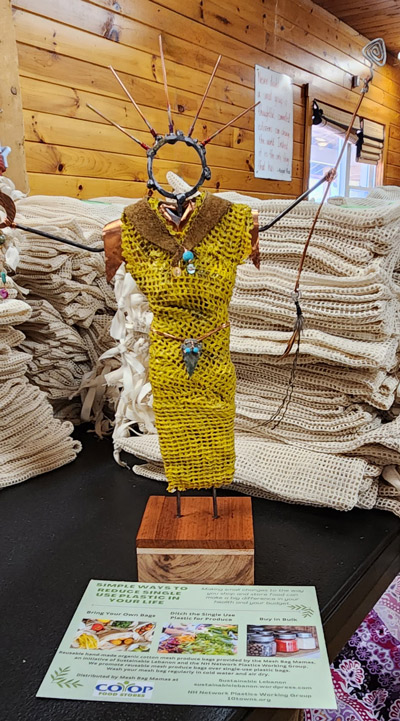
The Mesh Bag Mama mascot, created byCornish-based metal artist, Joanne Clifford

The Mesh Bag Mama mascot, created by Cornish-based metal
artist, Joanne Clifford

Joan runs “Fat Hat”, as it is fondly known locally, with her daughters Sara and Jenn, along with professional pattern maker, Lak Vorachek, and several sewers. Each season’s clothing designs are sewn in New York in a facility that is open, airy, comfortable, and with safe working conditions for the sewers. In addition to keeping the business humming along serving 130 boutique clothing stores across the country and the national catalog Artful Home, the trio has supported a number of community causes over the years. The Fat Hat team made masks to sell all over the country to keep the staff employed during COVID and donated free Fat Hats to cancer patients nationwide in honor of Joan’s mother.

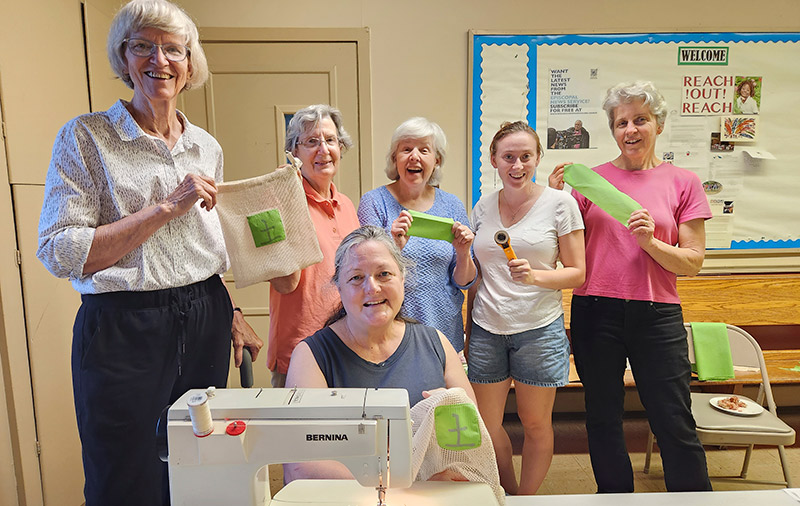
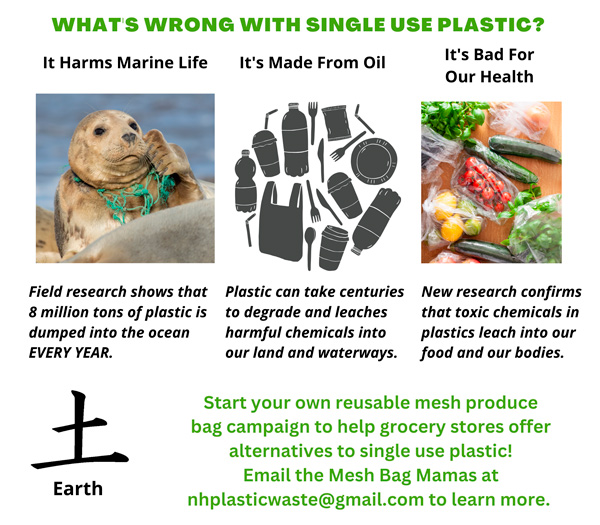
Most recently, Joan agreed to support the “Mesh Bag Mamas” project, an initiative of the NH Network Plastics Working Group. The project offers free, handmade reusable mesh bags to area grocery stores to encourage customers to ‘Ditch the Produce Plastic’ and reduce single-use plastic bag waste and pollution. The bags are made of washable organic cotton mesh decorated with the Japanese symbol for Earth, and they can transport fruits and vegetables home before they’re stored either in the refrigerator or on the counter top. Included with each bag is a postcard that outlines the hazards of single-use plastic and how to reduce its use to live a more sustainable lifestyle.

The Mesh Bag Mamas project began in 2023, with 30 volunteers from around the Upper Valley sewing 1,200 bags for distribution at area co-ops and grocery stores. Funding was provided by the Food Co-op, Sustainable Lebanon, Community Action Works, and private donations. NH songwriter, Mary Armstrong, wrote the “Mesh Bag Mama” song, which was performed at the Lebanon Co-op, and metal artist, Joanne Clifford, of Cornish created the Mesh Bag Mama mascot – a metal sculpture of a goddess wrapped in scraps of mesh. Fundraising efforts for supplies and labor for the project are ongoing by members of the Plastics Working Group, and the first round of 250 bags will be made available at the Woodstock Farmers Market this summer. Amelia Rappaport, a manager at the market, says the bag project aligns with the market’s sustainability efforts: “We love reusable bags, and would love for everyone to have them!”

Interestingly, Vermont has had a ban on single-use items in place since 2020, which includes plastic bags, but only covers bags distributed at the check out. The use of single-use plastic bags in grocery store produce and bulk departments is one of the exceptions to the law, so giving customers the choice for a reusable produce bag furthers the reduction of single-use plastic.

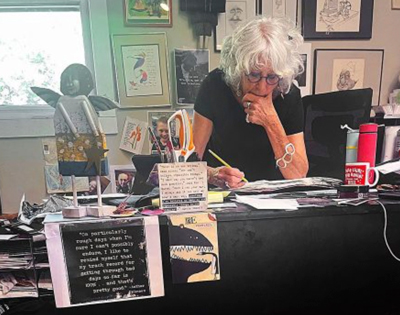
Joan Ecker, owner of F.H. Clothing Co. in Quechee

Joan Ecker, owner of F.H. Clothing Co. in Quechee

F.H. Clothing Company provides space for the cutting of the mesh bag material, and the bags are sewn at the home of one of Fat Hat’s part-time employees. Joan explains what inspired her to support the Mesh Bag Mamas project: “It’s always nice to participate in things that touch the community in some way. We’ve got to be concerned about the environment and continue to raise consciousness.” Joan foresees being able to continue to support the project around the company’s seasonal schedule, engaging other sewers as time goes along and demand for the bags increases.

Sara Ecker oversees the informal sustainability efforts for Fat Hat and notes several practices the company uses to try to reduce waste from purchasing goods to production, shipping garments to retailers, and store operations. “We try hard not to overbuy fabric or goods so we don’t have a lot of leftover yardage and garments, but this is also customer-driven. We donate clothing we don’t sell to Apparel Impact (a non-profit redistributing clothing to those in need) and to the Lyndonville Thrift Store during the recent floods because a lot of people lost their homes,” says Sara. “We also donate fabric, buttons, and other materials to area senior centers and afterschool programs.”

Fat Hat clothing is intentionally made to last, which is often not the case in the fashion industry. The company also uses recyclable bags for its shipping operations, and paper bags are used in the retail store. Jenn runs the retail store and even sources the ribbons used to wrap packages from a company that uses 100% compostable, water soluble material, non-toxic adhesives, and ink that is chlorine and acid free. You can leave the ribbon for the birds in your neighborhood or in the garden for safe nest building. Garment boxes are purchased from New England based company Packaging Specialties and are made of recycled material along with the bags, jewelry boxes, and small gift boxes. Both the ribbon company and Packaging Specialties offer carbon neutral shipping.

While many textile businesses and fashion designers come and go with the trends of the day, F.H. Clothing Company has stayed the course, developing a loyal customer following for its comfortable, sophisticated clothing lines, and its design mantra, “clothing that loves you just the way you are.” As a lifelong entrepreneur, Joan Ecker has perfected the art of continuous learning, decisiveness, curiosity, and willingness to experiment with new ideas.

From the first Fat Hats in New York to a thriving clothing business in Quechee, Joan describes the company’s evolution on her website. “After all these years, it strikes me that we’re not making and selling clothing at all…we’re selling our sense of humor, our independent Vermont lifestyle, and our comfortable attitude about dressing… clothing is just how we’ve packaged it!” F.H. Clothing Company is a great example of a business that can be successful, enduring, and make intentional choices to care for the planet.

For more information on the Mesh Bag Mama project, visit the Ten Towns Ten Actions website at 10towns.org.  

Share:
Reading time: 5 min
Page 3 of 23« First...«2345»1020...Last »

Our Latest Issue

The Quechee Times is mailed to every address in Quechee and to all Quechee Lakes members at their primary residences.

  • Pick up a copy!

© 2024 copyright Greater Good Media. All rights reserved.