Most Upper Valley residents are familiar with Quechee Gorge, a majestic natural wonder carved out by the Ottauquechee River, and at 165 feet, the deepest natural gorge in the state. Ottauquechee means “swift mountain stream,” a name likely bestowed by the Abenaki people who first settled along the river.
The village of Quechee is one of five in the town of Hartford, but it has become an attractive tourist destination, not only because of the gorge and the state park, but for attractions like the restored covered bridge leading into the village, popular restaurants, diverse shops, and many outdoor recreation activities.
The gorge is also home to the Quechee Gorge Visitor Center and the Hartford Area Chamber of Commerce, operating in partnership with Vermont State Parks, which operates the nearby Quechee State Park, and the U.S. Army Corps of Engineers, which owns the 612-acre park and the building that houses the visitor center. Buzzing with activity seven days a week, the visitor center is a popular stop for tourists and locals who want to hike down to the dramatic gorge or view it from the adjacent bridge. According to the Vermont Tourism Office, the Quechee Gorge Visitor Center receives about 100,000 visitors each year.
The center in the fall.
The staff at the visitor center are already serving visitors from around the world, according to Nikki Bacon, the newest staff member at the center. “Already this year we’ve had visitors from 49 countries — the Congo, Austria, Pakistan, and people from countries all over Europe.” Most visitors who come through speak English, so the staff is able to share information and communicate effectively about the opportunities and attractions in the area. Among the most common questions the staff receives are “Where is the gorge?” and “How do we get to the gorge?” “Do we have to hike or can we use the bridge walkway?” The staff encourages visitors to cross the bridge for the best photo opportunities, but the hiking trail to the bottom of the gorge is accessible to all ages and abilities, including people with strollers and wheelchairs. “The state park staff does a tremendous job of maintaining the trail with hard pack surfacing and clear signage,” said Nikki.
The visitor center has numerous displays, including historical maps and displays of the Quechee Gorge over the years, and stories of the early mill days in Quechee showcasing the grain, lumber, cider, and textile mills that made uniforms for the Boston Red Sox and the New York Yankees, among many other products. Conservation efforts are also on display at the center, as well as photographs of the impact of hurricane Irene. Last year, the center began exhibiting artwork by Vermont artists along with handicrafts, Vermont-made food products, light refreshments, and sparkling clean public restrooms.
The visitor center receives about 100,000 visitors each year.
Overseeing the visitor center is Hartford Area Chamber of Commerce Director Havah Armstrong Walter, who was hired by the Chamber Board of Directors nearly three years ago. Originally from rural Maryland, Havah attended a summer language course at Middlebury College and was intrigued by the similarities between Vermont’s landscape and her grandparents’ farm in Maryland. “It was a really nice farming community where everyone helped each other out, and I had that same experience in Vermont with people helping me find a place to get flowers to decorate my room and taking me to special places like Texas Falls and Mozart in the Park. It was an incredible summer,” she said.
Havah returned to University of Pittsburgh where she was studying and shared her excitement with her fiance, and they made the move to Vermont, where she went on to earn a master’s degree in globalization at Dartmouth. Fully intending to work for international organizations like USAID, UNICEF, her path shifted as she realized she was fully immersed in her life in Hartford. “We felt very rooted in Vermont, and attached to our friends, neighbors, and the Sunrise Farm Community Supported Agriculture (CSA) program,” she said. “We knew farmers, artists, restaurant owners, and felt very integrated into the community.” Havah revised her plans and decided to “be of good use” locally instead of globally, and she and her husband elected to stay in Vermont and raise a family.
Patrons visiting the Quechee Gorge Visitor Center
Having lived in four out of the five villages in Hartford over her 26 years in the Upper Valley, Havah has held many leadership roles, including girl scout leader, cub scout den leader, and lacrosse club involvement to support her children. She also has been engaged in local and state communities by serving on the school board, a diversity and equity committee, the Governor’s Council on Developmental Disabilities, and providing nonprofit consulting services. “I enjoy helping very passionate organizations develop their expertise in friendraising and fundraising and expanding their impact,” she said.
Leading her own nonprofit, Start Change, connected Havah with a diverse array of leaders in the Hartford community, including area Chambers of Commerce with whom she partnered on marketing, stewardship, and networking to support her nonprofit consulting clients. In 2023 Havah was invited to apply for the Hartford Area Chamber Executive Director position, and was hired for the job.
Quechee Gorge Visitor Center Entrance Sign
Havah has overseen several initiatives that have had a positive impact on the Quechee Gorge Visitor Center. “We started with transitioning operations to a digital platform including banking, record keeping, and ticket sales for the Quechee Balloon Fest, which resulted in higher revenues.” In addition, shifting from volunteers at the visitor center to 100% paid staff has helped the center adjust to post-COVID staff coverage challenges. Training staff in professional tourism management skills has seen visitorship in the foliage season increase 15-20%. “Our staff has always excelled at customer service, and we have amazing volunteers,” she said. “I joke that one of the things I did here at the center is that ‘I girled it up a little bit’. We have our second artist in residence here this year exhibiting their work in the visitor center. M. Julian Isaacson of Stone Revival Gallery features stone carvings, and last year nature focused block printer Landa Townsend filled the role.”
The Quechee Gorge Visitor Center and the Hartford Area Chamber of Commerce are evolving with the times and expanding their reach within the context of the ancient geology and ecology of Quechee Gorge by continuing to prioritize partnerships and collaborations. Said Havah, “We love to support small businesses and small business owners in our community in the way that they need through membership or simply representation.” And with that, let the summer begin! n
The Quechee Club was certainly rockin’ and rollin’ on a Saturday night in July when it hosted the 23rd Annual CHaD Gala, presented by QLLA Charities. More than 120 guests joined in the fun, all to benefit the Ken & Vickie French Child Advocacy and Protection Program (CAPP) at Dartmouth Health Children’s. This year’s theme was “Rock ’n’ Roll for the Kids” and many of the guests had fun interpreting that theme through their choice of dress–with some definite attitude thrown in! There were hippies alongside country music fans, greasers, a few sock hoppers, a flapper, and some hard core hard rockers! “Celebrities” made appearances, too – ”Madonna” stopped by as did “Stevie Nicks” and lots of folks who looked like they just flew in from the London club scene or Haight-Ashbury! Kudos to Madison and Ryan McDuff who took the prize for best-dressed with their very cool Sonny & Cher look!
On the Highland golf course supporting the Classic (L-R): Eric Bradshaw (chair), Julian Jaworski, Eric Emery, Darren Linder.
An addition to our fundraising totals this year are the proceeds from the first annual QLLA Charities & Quechee Otters Swim-a-Thon. Twenty-six swimmers participated in early July raising nearly $2,700 to be included with the Classic and Gala funds. A presentation was made during the Gala to the new chair of the CAPP program, Dr. Amy Roy. The swim-a-thon was created with the thinking that it would be a great way to include some of the community’s younger families in a fundraising activity while at the same time introducing kids to the idea of philanthropy and giving back. Diane Fokas and Susan Carey, co-chairs of the event, look forward to an even bigger turnout next year as word of how much fun it was is spreading! The Otters are Quechee Club’s swim team.
Funds raised this year by QLLA Charities for the CAPP program, including the CHaD Classic Golf Tournament (held in June) and the CHaD Gala, total more than $117,000 with donations still coming in. Together with Dartmouth Health Children’s and the kids who are served by their state-of-the-art programming and dedicated, compassionate staff, we express our sincere gratitude for the support of the Quechee community. The importance of philanthropy to these programs cannot be understated. When a community such as ours comes together to lend a hand, the sky’s the limit in providing hope to the kids who are our future. Until next year…
Gala volunteers in front of the Wall of Hope (L-R): Cindy Gould (interim chair of the Gala), Shantel Bill, Phyllis Shankman, Dawn DeStefano, Linda Bradshaw, Gail Ferney, Katie Liptak.
Quechee’s venerable F. H. Clothing Company owner, Joan Ecker, designed and produced her first “Fat Hats” 46 years ago on a human-powered treadle machine, selling them out of a wooden barrel at craft fair shows all over the Northeast. On one occasion, while selling in front of Lincoln Center, a New York Times reporter asked what else she made. Joan spied a passerby in a poncho – a popular garment at the time – and said “ponchos!” Soon after, while caring for her young children as a single mom, Joan made the proverbial leap into entrepreneurship and never looked back. Joan’s straightforward personality and ‘can-do’ attitude led to bartering with a builder friend willing to trade his carpentry skills to help construct her dream home for a “warm, fun hat” from her then sewing workshop, set up outside under a tarp. It’s this kind of collaborative thinking that has grown the F.H. Clothing Company into not only a successful clothing company, but also an environmentally conscious business that supports the local community.
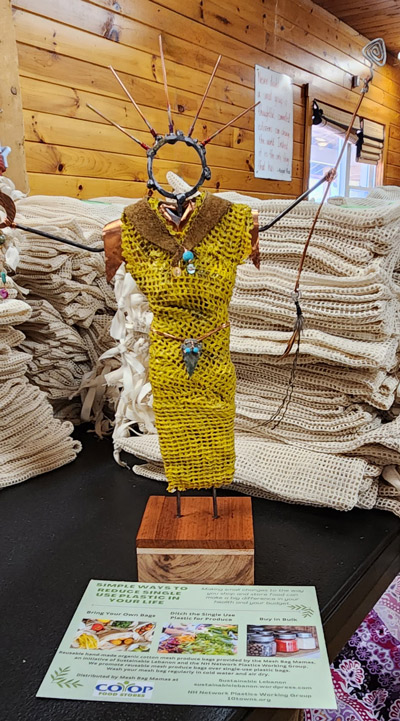
The Mesh Bag Mama mascot, created by Cornish-based metal artist, Joanne Clifford
Joan runs “Fat Hat”, as it is fondly known locally, with her daughters Sara and Jenn, along with professional pattern maker, Lak Vorachek, and several sewers. Each season’s clothing designs are sewn in New York in a facility that is open, airy, comfortable, and with safe working conditions for the sewers. In addition to keeping the business humming along serving 130 boutique clothing stores across the country and the national catalog Artful Home, the trio has supported a number of community causes over the years. The Fat Hat team made masks to sell all over the country to keep the staff employed during COVID and donated free Fat Hats to cancer patients nationwide in honor of Joan’s mother.
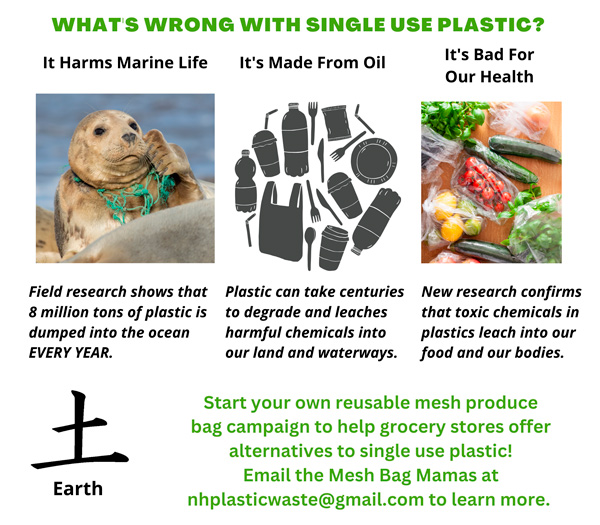
Most recently, Joan agreed to support the “Mesh Bag Mamas” project, an initiative of the NH Network Plastics Working Group. The project offers free, handmade reusable mesh bags to area grocery stores to encourage customers to ‘Ditch the Produce Plastic’ and reduce single-use plastic bag waste and pollution. The bags are made of washable organic cotton mesh decorated with the Japanese symbol for Earth, and they can transport fruits and vegetables home before they’re stored either in the refrigerator or on the counter top. Included with each bag is a postcard that outlines the hazards of single-use plastic and how to reduce its use to live a more sustainable lifestyle.
The Mesh Bag Mamas project began in 2023, with 30 volunteers from around the Upper Valley sewing 1,200 bags for distribution at area co-ops and grocery stores. Funding was provided by the Food Co-op, Sustainable Lebanon, Community Action Works, and private donations. NH songwriter, Mary Armstrong, wrote the “Mesh Bag Mama” song, which was performed at the Lebanon Co-op, and metal artist, Joanne Clifford, of Cornish created the Mesh Bag Mama mascot – a metal sculpture of a goddess wrapped in scraps of mesh. Fundraising efforts for supplies and labor for the project are ongoing by members of the Plastics Working Group, and the first round of 250 bags will be made available at the Woodstock Farmers Market this summer. Amelia Rappaport, a manager at the market, says the bag project aligns with the market’s sustainability efforts: “We love reusable bags, and would love for everyone to have them!”
Interestingly, Vermont has had a ban on single-use items in place since 2020, which includes plastic bags, but only covers bags distributed at the check out. The use of single-use plastic bags in grocery store produce and bulk departments is one of the exceptions to the law, so giving customers the choice for a reusable produce bag furthers the reduction of single-use plastic.
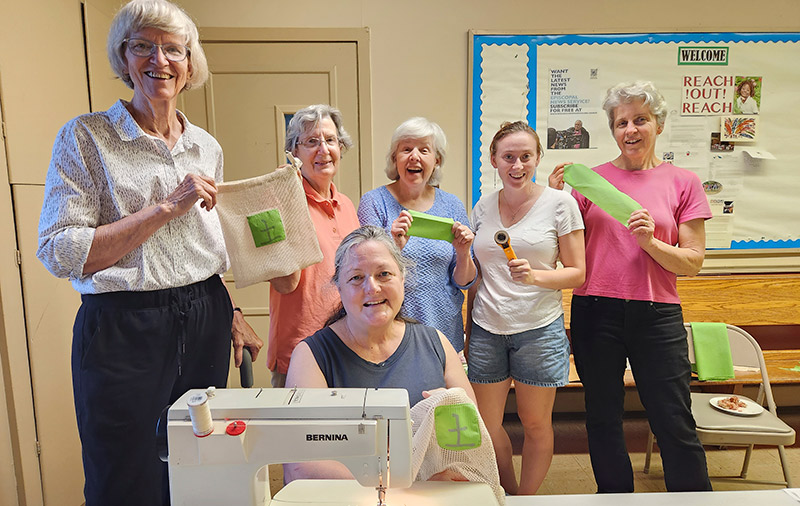
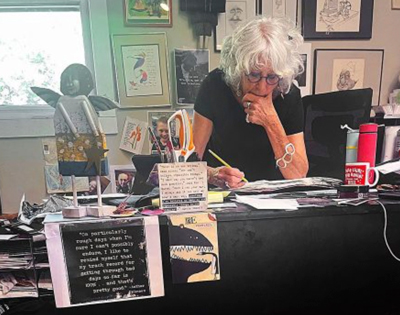
Joan Ecker, owner of F.H. Clothing Co. in Quechee
F.H. Clothing Company provides space for the cutting of the mesh bag material, and the bags are sewn at the home of one of Fat Hat’s part-time employees. Joan explains what inspired her to support the Mesh Bag Mamas project: “It’s always nice to participate in things that touch the community in some way. We’ve got to be concerned about the environment and continue to raise consciousness.” Joan foresees being able to continue to support the project around the company’s seasonal schedule, engaging other sewers as time goes along and demand for the bags increases.
Sara Ecker oversees the informal sustainability efforts for Fat Hat and notes several practices the company uses to try to reduce waste from purchasing goods to production, shipping garments to retailers, and store operations. “We try hard not to overbuy fabric or goods so we don’t have a lot of leftover yardage and garments, but this is also customer-driven. We donate clothing we don’t sell to Apparel Impact (a non-profit redistributing clothing to those in need) and to the Lyndonville Thrift Store during the recent floods because a lot of people lost their homes,” says Sara. “We also donate fabric, buttons, and other materials to area senior centers and afterschool programs.”
Fat Hat clothing is intentionally made to last, which is often not the case in the fashion industry. The company also uses recyclable bags for its shipping operations, and paper bags are used in the retail store. Jenn runs the retail store and even sources the ribbons used to wrap packages from a company that uses 100% compostable, water soluble material, non-toxic adhesives, and ink that is chlorine and acid free. You can leave the ribbon for the birds in your neighborhood or in the garden for safe nest building. Garment boxes are purchased from New England based company Packaging Specialties and are made of recycled material along with the bags, jewelry boxes, and small gift boxes. Both the ribbon company and Packaging Specialties offer carbon neutral shipping.
While many textile businesses and fashion designers come and go with the trends of the day, F.H. Clothing Company has stayed the course, developing a loyal customer following for its comfortable, sophisticated clothing lines, and its design mantra, “clothing that loves you just the way you are.” As a lifelong entrepreneur, Joan Ecker has perfected the art of continuous learning, decisiveness, curiosity, and willingness to experiment with new ideas.
From the first Fat Hats in New York to a thriving clothing business in Quechee, Joan describes the company’s evolution on her website. “After all these years, it strikes me that we’re not making and selling clothing at all…we’re selling our sense of humor, our independent Vermont lifestyle, and our comfortable attitude about dressing… clothing is just how we’ve packaged it!” F.H. Clothing Company is a great example of a business that can be successful, enduring, and make intentional choices to care for the planet.
For more information on the Mesh Bag Mama project, visit the Ten Towns Ten Actions website at 10towns.org.
For Quechee resident Kristen Lessard, organizing volunteers for the annual Woodstock Wassail Weekend is a fantastic way to get to know area residents and visitors, and to welcome the holiday season. With its milestone 40th anniversary fast approaching this December, this year’s Woodstock’s Wassail Weekend is sporting renewed energy and expanded event offerings targeting families, long-time residents, and visitors to the area.
With the long days and nights of the New England winter approaching, Wassail Weekend represents an opportunity for us to enjoy a bright and cheerful event of the season. The event brings light and good cheer to downtown Woodstock, with the hope that the festive mood will help carry us through the long winter until spring returns.
Last year’s Woodstock Rotary Gala, with Quechee resident Kristen Lessard, Mary Bourgeois, Belinda Needham-Shropshire
The newly formed Woodstock Wassail Committee, composed of area businesses and volunteers from Woodstock, Quechee, and surrounding towns, has been meeting monthly throughout 2024, and the group is excited to share the reworked event on December 13-15 in Woodstock. The committee is working with the Woodstock Area Chamber of Commerce – the event’s main sponsor – to continue the parade’s legacy, and the annual Wassail Weekend Getaway raffle has already kicked off its ticket sales with gift certificates to area businesses and restaurants, and a weekend at the Woodstock Inn & Resort. Thousands of people from around the country have historically attended the weekend’s festivities.
Recruiting volunteers, including outreach to Quechee residents, is about to get underway, and Kristen has a number of strategies in mind to seek out volunteers. “One of the things I’ll probably do is to post a request on the Quechee FB page,” she says. Kristen is excited about the return of more equestrian events in the annual parade this year, one of several enhancements to the Wassail event, along with a new crafts fair to be held inside the covered bridge downtown. “The committee was brought together much earlier this year…we’re working hard to bring this [event] to a new level.”
The lighting of 400 luminaries on the Woodstock green organized by the Woodstock Rotary Club adds to the festive flair, and the iconic Wassail Parade will take place on December 14 at 2pm, featuring elaborately decorated carriages reminiscent of a Currier & Ives Victorian celebration.
As a member of the Woodstock Rotary Club, Kristen has found that volunteering in community events since relocating to Quechee in 2015 has given her the opportunity to really get to know her neighbors, both in Quechee and in the Woodstock area community. “There’s so much opportunity to do good things in Quechee,” she says. “The Rotary Club has always been involved in Wassail, and there are a number of volunteers from Quechee who volunteer on the Wassail project.”
Fellow Quechee resident and Rotary volunteer, Belinda Needham-Shropshire, echoes Kristen’s appreciation for the Quechee community. “Quechee is halfway between Woodstock and Hartford, and the reason I’m part of the Woodstock Rotary is because I grew up in Bridgewater, and went to Woodstock High School,” she says. “My husband and I were looking for a home along the Route 4 corridor, and we fell in love with Quechee because it was easy to get to my mom in Bridgewater and close to his work.” Belinda notes that she and her husband can walk to downtown Quechee, and were frequent visitors to the Quechee Ski Hill with their children. “It’s been a perfect location for us for the 27 years we’ve lived here, and we’ve met a lot of great people.”
Belinda appreciates the beauty of Wassail Weekend, including the many horse-drawn carriages, the beautiful period costumes, and the caroling. Residents around the Green open their homes to display holiday decorations as well. “Two years ago, the Hallmark Channel came to film some footage of the event, and a visitor told me that it really was like a Hallmark movie,” she says. There is something for everyone at the event: “Children come out to join the parade with their dogs, and the Green is absolutely stunning when the luminaries are lit,” Belinda adds. “It really gives you the spirit of the season and makes you want to give your neighbor a hug.”
The event draws inspiration from the traditional English Yuletide beverage, “Wassail”, historically a communal bowl of hot spiced cider, ale, or wine passed around to celebrate community and togetherness. This ancient tradition remains central to the Woodstock celebration today.
Another aspect of the tradition, though rarely practiced today, is ‘wassailing’, which involves either singing door-to-door or blessing the apple orchards in the countryside to summon a good harvest the following year. According to the Woodstock Wassail Weekend website, British villagers believed that the spirits who lived in the apple orchards needed to be appeased during the winter months with twilight processions and a bowl filled with the spiced Wassail ale or cider to insure a successful harvest in the year ahead.
The annual Wassail parade during Wassail Weekend features horses, festive cheer, and community spirit. PHOTO FROM 2015 BY ABBY ROWLEE
One milestone event this year has been the restoration of the star on the top of Mt. Tom. The original wooden star, in place and traditionally lit November through March, has been replaced with a metal version, and will continue to be a part of the Wassail Weekend celebration as it has for the past 40 years. The Woodstock Rotary raised the $120,000 needed to replace the star for future generations to enjoy. As a former president of the Rotary Club, Kristen applauds fellow Rotarian, Norm Frates, and a team of volunteers for getting the new star in place with the help of a large crane.
Other events planned for the weekend include a candle light walk through downtown Woodstock, with a bagpiper descending from Mt. Tom to the Green, children’s stories and ornament making, a book sale, music and singing, a portrayal of Dylan Thomas’ A Child’s Christmas in Wales, carriage rides, a yule log, holiday artisan’s market, traditional Wassail punch tasting, and fire pits and s’mores stations.
Many partners come together to make the weekend a success, including Billings Farm & Museum, the Woodstock Inn & Resort, Mascoma Bank, Rotary Club, Pentangle Arts, and the Town of Woodstock, along with many local arts venues hosting musical events. Kristen notes that Quechee residents are welcome to join the Wassail Weekend effort, as well as Woodstock Rotary, to become involved in this and other festive holiday events in the community.
Join the festivities at the upcoming (40th annual) Wassail Weekend on December 13-15! The Wassail Parade will take place on Saturday, December 14 at 2pm. For more information, visit the Woodstock Wassail Weekend website at woodstockvt.com.
If you were in elementary school in the 1960s, chances are you were one of nearly 50 million people who watched the historic launch of the first astronauts, known as the Mercury 7, into orbit around the Earth. All of those original astronauts, including John Glenn and Alan Shepard, have passed away, but their legacy of space exploration and the search for life on other planets, including Mars, is firmly established through the continuing work of the National Aeronautics and Space Administration (NASA).
For Quechee resident Stephen Gorevan, a robotics engineer and co-investigator with the Mars Science Laboratory Mission at NASA, the Mercury 7 launch inspired a lifelong career supporting NASA space exploration. “For me, it was like, “Wow!”, and I was hooked,” Stephen says, remembering watching the launch as a young child on a television placed on the stage in his public school cafeteria. “I didn’t want to be an astronaut, but I did want to be part of our efforts to go to the Moon.”
Stephen Gorevan
Stephen initially thought that his chances of joining NASA were slim because all of the programs were based in Texas, California, and Florida, and he was from New York. “I thought, ‘they’re not going to let me get involved’. So I went to music school, and forgot my dreams of working at NASA,” he says. Eventually, pursuing his lifelong dream won out, and Stephen left music school and transitioned to studying engineering, earning a master’s degree from Columbia University. “My best friend offered to start a business together, and in 1983, we founded Honeybee Robotics. We were young upstart kids who were studying robots in college, and at that time, businesses like IBM, 3M, and FedEx all wanted to automate.”
The stars were aligned for introducing robotic engineering to space missions as well. With the tragic explosion of the Challenger spacecraft, NASA decided to turn the dangerous jobs over to robots. “I got an appointment with a NASA employee just by serendipity and got my dream job at NASA,” Stephen says. “When President Clinton announced that it looked like there might be life on Mars, it opened the floodgates to explore Mars with robotic devices. Suddenly, I found myself going from a small company in New York to helping NASA explore Mars.”
Honeybee Robotics supported the 2004 Spirit and Opportunity missions to Mars, supplying scientific instruments on both missions, which allowed the collection of new data not possible on previous explorations. “My job was to send data collection commands to the rovers exploring Mars,” Stephen says. According to NASA, Spirit and Opportunity confirmed that water was long standing on the surface of Mars in ancient times by studying the rock record, an indication that life might have been present on the ‘red planet’.
Stephen continued his work with three more rovers – Curiosity, Perseverance, and the Phoenix Lander, exploring craters and other areas on Mars. Right from his cabin in Quechee, he now sends daily commands exclusively to the Curiosity rover – the most advanced rover NASA had designed to date when it launched in 2012. “When it’s my turn to ‘uplink’ a command set to Curiosity, I am specifically acting as a Payload Uplink Lead (or PUL) sending a program to an instrument suite on Curiosity named SAM (Sample Analysis at Mars),” Stephen explains. “The SAM team decides they want to run an experiment on Mars and a team of engineers like me participates in a careful execution of what the science objectives are.”
Stephen prepares two days in advance of the uplink process to be sure the program is correctly designed. “The day of uplink, I am looking out of my picture window [in Quechee] with Moosilauke in the distance, and I am online with about 50 engineers and scientists as we refine our commands over the course of an eight hour day, culminating with the commands being sent to Mars by large antennas in California, Spain, and Australia,” he says. Stephen notes that the uplink process is intense because ‘no mistakes’ is the goal, but working remotely from the bucolic Upper Valley helps ease some of the tension. The whole process of implementing the computer program some 140 million miles from Earth takes several hours from uplink to receiving results. Curiosity is looking for ancient habitats on Mars that would have been suitable for life fossils of amoebas and microbes, but its primary mission is to study rocks, dirt, and geoformations, as well as minerals like granite, iron, basalt, and sulphur.
So what are the space rovers learning? According to Stephen, NASA’s #1 priority is to understand the mystery of the origin of life. “If any other planet is going to support life, it’s Mars because it’s so close,” he says. “What we have proved so far is that there were seas, lakes, oceans, and rivers on Mars. Anywhere on Earth where there is liquid water, there is life.”
After decades of exploring Mars and analyzing the data, an important discovery is that the ultraviolet and cosmic rays hitting the surface of Mars are so intense that humans would not survive being exposed to them, but still there’s hope. “We’re close,” says Stephen. Ten years ago, an instrument Stephen programs – the tunable laser spectrometer – discovered high levels of methane on Mars. “Methane can be produced from volcanoes, geysers, and microbes. Scientists suspect microbes, because they show up on many mornings, and there are no volcanoes on Mars.”
Before working on Curiosity, Stephen worked for 20 years on the Spirit and Opportunity Rovers. His group of Honeybee Robotics engineers designed and built the Rock Abrasion Tool pictured.
NASA’s work continues with new missions to Europa (a Jupiter moon), Venus, our Moon, and unobstructed observations of the Milky Way. As a member of NASA’s Curiosity Science Team, Stephen works from his home in Quechee and often travels to NASA’s Jet Propulsion Lab in California. He recently sold Honeybee Robotics to Blue Origin, a space exploration company owned by Jeff Bezos.
Future NASA missions will gather actual Martian rocks for analysis and bring them to Earth. Still, it’s likely that if humans were ever to live on Mars, it would have to be underground, and any outside activity would require a space suit. “I admit, I prefer to do my planetary exploration from my kitchen table,” Stephen says.
For more information on the Curiosity mission, visit NASA’s website science.nasa.gov.
When the Ottauquechee School Girls on the Run (GOTR) program was founded 15 years ago by 5th grade teacher Sandra Rhoades, the 24 member team became part of what is now a 25 year statewide legacy of supporting girls in 3rd through 5th grade in developing confidence, life skills, and a love of physical activity. Girls on the Run Vermont is one of the oldest ‘councils’ in the country; collectively, its 120 programs have reached more than 39,000 girls and thousands of coaches over the course of 25 years, averaging 550 volunteer coaches each season.
Hannah Whitney and her mom, Becky, share a special moment before the 5K celebratory race in Essex.
So what exactly is Girls on the Run? The national non-profit was founded in North Carolina in 1996 and is now active in all 50 states. GOTR offers a research-based curriculum that focuses on positive youth development paired with physical activity, primarily running. Research has shown that even today, girls can have limited access to physical activity and less social support for participation. Despite the advances in girls and women’s sports since the passing of Title IX – a law requiring equal funding and access to sports – inequalities still persist. The Girls on the Run mission and vision explains it well: “We inspire girls to be joyful, healthy and confident using a fun, experience-based curriculum which creatively integrates running. We envision a world where every girl knows and activates her limitless potential and is free to boldly pursue her dreams.” Coaches receive extensive training in the program lessons, hands-on skills, and role playing, and the curriculum is refreshed every three years to incorporate new language and expand accessibility.
For Sandra Rhoades and her teaching colleagues – Nancy Burke and Gigi Stone – who subsequently joined the coaching team, GOTR has been a fun way to engage with students outside of the classroom and support girls in reaching their full potential. Sandra notes, “Girls on the Run is more than just running. The main focus is the lessons and on becoming a strong, empowered young woman. The running activities are designed around the curriculum.” Sandra began running and competing at age 35 and fell in love with the sport, running in the Western NH Trail Running series and the Covered Bridges Half Marathon. She went on to co-coach the Hartford High School Cross Country team for 12 years. “Running is easy. You just need a pair of sneakers; it doesn’t cost a lot of money, there’s no gym membership, and you can run when you want to.”
Dads on the Run Chris Baker and Even Eccher joined in the fun with their daughters Emma and Berkely.
Sandra notes that girls who participate experience the same lessons each season, with different activities introduced along the way. “At the end of each 10 week season, we do a reflection, and some of the lessons come out as favorites – the lessons about gossip (you can’t put the toothpaste back in the tube), body imaging (it’s what’s on the inside that counts, not on the outside), and loving yourself no matter what you look like in particular.” Among Sandra’s favorite aspects of the program are the conversations with the girls, and seeing the impact the program has back in the classroom. “Often, the girls will tap into the GOTR skills like stopping to take a breath before reacting to a situation and expressing themselves more confidently over the course of the program in school and at practice.”
For their part, assistant coaches Nancy and Gigi, 14 and six year veterans of GOTR respectively, echo the benefits of the program in helping girls find their “star power”, (one of the curriculum lessons), as well as other life skills. The program specifically addresses topics and challenges that girls encounter during late childhood and adolescence. Nancy recalls one girl early in the program who didn’t say much in school and wasn’t really connected with her classmates. “Through the program she found her voice, participated, laughed, and made friends, which probably wouldn’t have happened if she hadn’t been in the program. She built her confidence both in GOTR and in the classroom,” she says. Gigi shares a similar story of transformation: “It’s great to hang out with the girls in a casual setting as opposed to the classroom and keep the relationships going. Girls who may have been overwhelmed at first seem to experience the greatest transformation over the course of the program, because they often don’t think they can do it when they start, and are so proud of themselves when they participate in the end of the season 5K fun run.”
Retiring Girls on the Run and Ottauquechee School teachers, Sandra Rhoades and Nancy Burke
Over the 25 years that Girls on the Run Vermont has been operating (the state organization is led by professional staff), the main mission and message has remained the same with curriculum adaptations every three years to address emerging social conditions. GOTR Vermont founder Nancy Heydinger recalls being inspired by the idea that a nurturing environment could help girls reach their full potential. “I decided to do something that would positively impact and benefit young girls’ lives. I felt that I had found the formula in GOTR – that combining physical activity, team building, encouragement, and fun would bring about increased self-esteem and health. It was so important to me to give my daughters opportunities and experiences that would inspire them to believe in themselves and give them tools and strategies to navigate life.”
The statewide 5K fun run is the culminating event of the program, and most girls have a running buddy but it is not required as long as they run with a group. One of the themes of the non-competitive event is something that is emphasized during the season: “You don’t have to keep running, but you do have to keep moving.” The event is a chance for the girls to come together in a fun atmosphere and meet other program participants. According to current GOTR executive director Rachel Desautels, “…the Manchester 5K, one of two statewide events, hosted approximately 550 girls, 200 coaches, 250 running buddies, 150 volunteers, and numerous spectators cheering the girls on with cowbells and smiles!” Supporting fellow runners is a hallmark of the 5K event, so much so that this year the girls asked their coaches if they could join the final finishers as they neared the finish line. Coach Gigi notes, “When they support teammates, they are demonstrating kindness, compassion, and caring. Sometimes it takes going beyond your comfort level to have the courage to show you care.”
Many parents are involved throughout the season and are provided with an overview of the curriculum and activities they can do at home with their daughters to reinforce lessons like perseverance, making friends, and finding courage in tough situations. The hope is that the lessons will carry over beyond the GOTR program and into other life experiences. This has been true for several of the Ottauquechee GOTR alumna according to Sandra: “Quechee resident Maddie Carbino ran with us as a 5th grader; she ran track and cross country at Hartford Middle School, and will be running as a freshman at Hartford High School in the fall.” Maddie remembers the GOTR program fondly and credits the program activities and coaches for inspiring her to continue running. “We learned a lot about how your mental health helps with your running. We talked about emotions and we did a bunch of fun running activities that really stuck with me. The coaches made everyone feel like they could belong and I really liked that,” she says. GOTR alumna have gone on to race in college and there are even some Olympians with GOTR experience. Another way participants stay involved when they age out of the program is to become junior coaches.
Teammates cheer on 5th grader Emma Baker crossing the practice 5K finish line at Ottauquechee School
What about boys who like to run? This is a question that emerges from time to time, which the Ottauquechee School administration has proactively addressed by also offering a co-ed program called “Finding Our Stride”. An Upper Valley based initiative open to both boys and girls, the program is focused on fitness, social/emotional learning, and community engagement. All three GOTR coaches support broad participation, and also appreciate the focus on girls development that comes with a curriculum-based gender-focused program. “We feel strongly that having a program for just girls lets them say what they want without judgment and provides a safe space for them to become strong and confident as young women,” Nancy says. “They have a chance to grow and shine independently.”
Community service is a cornerstone of the GOTR program as well. Some of the local projects include working on the Ottauquechee Trail to build a bridge, sprucing up flower gardens at the school, creating musical instruments for the school playground, and helping Veterans put flags on graves in the cemetery near the school. The projects are girl-led and supported by parents, coaches, and community organizations.
At the end of this past spring season, Sandra, Nancy, and Gigi were honored at the Ottauquechee School by GOTRVT executive director Rachel Desautels and program coordinator Stephanie Dorgan, along with the school principal as they retired from their jobs in teaching as well as the GOTR program. “They have been mentors and positive role models for the girls in their elementary school by facilitating this program for so many years and have coached approximately 250 girls. I cannot express how much their dedication and love for their community has impacted our organization and helped foster the social, emotional, and physical well-being in 3rd-5th grade girls in Quechee,” Rachel says. Nancy Heydinger echoes the accolades: “Their commitment to ensuring that every girl has the opportunity to benefit from learning and practicing critical life skills, cultivating friendships, and experiencing the joy of physical movement is extraordinary.” Many former program participants and students wrote notes of congratulations for the time the coaches gave to the GOTR program as well as for their years of teaching at the Ottauquechee School.
The Ottauquechee School Girls on the Run team.
Sandra reflects on her tenure helping girls develop confidence and important life skills: “It’s nice to retire on the 25th anniversary of GOTR Vermont. There were special medals for the 5K race this year, and it’s an honor to have worked with the girls over the 15 years.” A 25th Anniversary Scholarship fundraiser has also been launched to support girls looking to further their education.
In coaching, there’s a saying: “You never know when you’re making a memory.” For these three coaches and the girls they’ve w orked with over the years, it’s certain that lifelong memories, as well as a solid set of life skills to lean on beyond the program for both the coaches and the girls, is part of the GOTR legacy.
For more information on how to become involved as a coach or team helper with the Ottauquechee GOTR program, contact Rachel Desautels, executive director at 802-871-5664, mrachel@girlsontherunvermont.org, or visit the GOTR Vermont website at gotrvt.org.
Much has been written about Quechee’s Whitman Brook, a lovingly restored orchard offering 143 varieties of heirloom apples originating in Europe and the United States. Now an award-winning documentary has been added to the orchard’s accolades. Whitman Brook and the Nature of Time by Norwich Writer/Director Ben Silberfarb beautifully captures the distinct seasons in the orchard and the moving story of its thoughtful founder and lead steward Terry Dorman and the people who work with him taking care of the land.
The poet Alexander Pope wrote a commonly used phrase in landscape and agricultural circles, ‘Consult the genius of a place in all.’ It’s clear from watching the film that the genius of Whitman Brook is the care and attention given to honoring the pace of nature in the orchard and the surrounding property of more than 200 acres. Appreciation for the natural world is evident throughout the property, and reaches back to Terry’s childhood experiences growing up on a former Massachusetts farm that had been in his family since the Revolutionary war. In the film, he shares his viewpoint. “I see the same tree about the same time every year to prune it. I can see the rhythm of the seasons. It’s an experience I wouldn’t get without being connected to the ground or nature in that way.”
From the film: Addie Gardner inspecting budding grafts
Whitman Brook and the Nature of Time embodies the concept of ‘the genius of a place’, telling a multi-layered story about rescuing a 100 year-old apple orchard tree by tree, the artful skills of pruning and grafting, and honoring the memory of Terry’s late wife Sara, who passed away from cancer in 2017. “Ben deserves virtually all of the credit for saying we had the potential to create a meaningful documentary,” says Terry. “What I set out to do was capture that we were doing something here more important than many people realize. My initial motivation was to have something for the archives after 26 years of caring for the land.”
When Ben began working on the project with Terry, he realized there was a deeper story to be told about the connection Terry and Sara originally had with the land and their decision to restore the orchard and surrounding property with a focus on conservation. “Terry filled the roles of both subject and producer, so I looked at it from a storytelling point of view. My primary role was to pull out the stories and unify them and Terry played a significant role in that.” The film took a bit less than 2 years to complete, and Ben shot a substantial amount of footage – 30 terabytes – which took thousands of hours to edit into the final version of the film. “I’ve made many films, but this was a unique situation. A good film should be easy to watch and have layers of different ideas that are unified into one story.”
A key contributor to the story of Whitman Brook is Addie Gardner, an eighth-generation Vermonter who came to work at the orchard after coordinating the vegetable farm and greenhouses at Killdeer Farm for 16 years. Addie brought her grafting skills and art training to the orchard as well as to the ornamental and vegetable gardens at Whitman Brook, and now prunes and grafts alongside Terry in the orchard throughout the season. She also has a hand in curating the extensive resource library at Whitman Brook, researching and selecting titles to add. “I think nature has always influenced my art, but it’s hard to replicate something that’s already beautiful. The idea of a well-pruned apple tree as a sculpture is pleasing for the eye and also pleasing for the plant.” The practice of grafting is thousands of years old, and seems to have emerged around the world at approximately the same time according to Addie.
Ben Silberfarb filming apple blossoms
Addie’s contribution to the film also highlights the meditative aspects of working at the orchard, and emphasizes the theme of taking one’s time and slowing down. “I like all the things that your mind conjures up when you think about time and where you are even in the last few hundred years, and the film’s restoration theme of putting effort into old things that work well and keeping things that should not be disposed of.”
Addie, Ben, and Terry all credit the time spent getting to know one another over meals as a vital component in the high quality nature of the film. “The time we spent getting to know each other was important. I don’t know if I would have expressed myself in the film the same way if we hadn’t had that,” says Addie.
Addie was pleased to discover values shared in common with Terry and Ben during the collaborative writing and filmmaking process – stewardship of the land, care for the environment, slowing down, appreciating the little things, seeing the extraordinary in the ordinary. “When I teach somebody how to prune or work on the property, I tell them ‘Just do it right’. We have to figure out how to do it right before we do it fast.”
Terry credits his parents, but in particular his mother, a writer for the Boston Globe who recently passed away at age 101, for his determination and drive. “My mother was my hero. It’s not that I didn’t have a great relationship with my father, but my mother and I understood each other. I like doing the best I can, and her endless curiosity and drive rubbed off.” Terry’s ‘day job’ is assisting companies that are struggling. “A big part of my job is persuading various constituencies involved with companies we work with to be patient. The things that I say in the film about moving slowly and intentionally I believe.”
In the orchard’s 1920’s block, originally Macintosh trees, now features grafted heirloom varieties that are popular with customers in the fall harvest season. Names like Newtown Pippin, Cox’s Orange Pippin, and Karmijn de Sonnaville sell out quickly. And of course, there’s the Oliver apple in honor of Terry and Sara’s dog by the same name. “Our changing of the varieties was to have a viable business. If we had a tree that we had too many of, it was pretty straightforward to graft a new variety that we wanted more of.” And like wine, the same apple variety can have a different taste depending on the ‘terroir’, the environmental conditions like soil, topography, and climate in which the fruit is grown.
From the film: Terry Dorman at his favorite tree
The process of making the film was a collaborative one, and Ben points to having the unusual gift of quality time to develop the story and craft the film. “Films work on many different levels –sound, aesthetics, story – and you aren’t often given the time to create something that people can absorb and respond to on many levels, which is the goal.” It took time to evolve the story to include both the technical aspects of how the orchard works as well as the human and emotional sides to the story like the film’s tribute to Sara, how to make the delicious Hewes apple sauce (‘no sugar or spices, just the apples’), and the parallels and contrasts between Terry’s day job and working in the orchard. “To really get at the best story, people need to let go of me hanging around with a camera. And that mixed well with Terrys’ style as the producer – he moves slowly, builds trust, and is cautious.” Ben notes that filmmakers are often forced into something that hasn’t been given much thought and likes to say, “On any hiking trip the best view is just a little further down the road, often further than most people are willing to go.” The film has a scene with Addie slowly counting back the rings of a tree that will be grafted to the year of her birth and beyond to illustrate the importance of taking the time to reflect on what came before us. “To keep the old varieties of apples around, it helps us understand ourselves better and our past better. They’re the fruit that our ancestors were eating,” says Addie. “Gnarled old trunks of trees that were there before you and will be there after you.”
The long-term vision for Whitman Brook is to create a public space with historic architecture projects, a conservatory, agriculture, culinary arts, fluvial systems, forestry, writing, and wildlife study. Terry has been steadily working toward that goal for more than 32 years. Parts of the property that were originally slated for development are now protected as wildlife habitat, and the land is largely contiguous to support animal migration and environmental conservation goals. “I’m staying true to my philosophy of doing the best quality possible.”
For more information on Whitman Brook visit the website, www.whitmanbrook.com. To learn more about Ben Silbfarb film visit
Much has been written about Quechee’s Whitman Brook, a lovingly restored orchard offering 143 varieties of heirloom apples originating in Europe and the United States. Now an award-winning documentary has been added to the orchard’s accolades. Whitman Brook and the Nature of Time by Norwich Writer/Director Ben Silberfarb beautifully captures the distinct seasons in the orchard and the moving story of its thoughtful founder and lead steward Terry Dorman and the people who work with him taking care of the land.
The poet Alexander Pope wrote a commonly used phrase in landscape and agricultural circles, ‘Consult the genius of a place in all.’ It’s clear from watching the film that the genius of Whitman Brook is the care and attention given to honoring the pace of nature in the orchard and the surrounding property of more than 200 acres. Appreciation for the natural world is evident throughout the property, and reaches back to Terry’s childhood experiences growing up on a former Massachusetts farm that had been in his family since the Revolutionary war. In the film, he shares his viewpoint. “I see the same tree about the same time every year to prune it. I can see the rhythm of the seasons. It’s an experience I wouldn’t get without being connected to the ground or nature in that way.”
From the film: Terry Dorman and Addie Gardener collecting scion wood
Whitman Brook and the Nature of Time embodies the concept of ‘the genius of a place’, telling a multi-layered story about rescuing a 100 year-old apple orchard tree by tree, the artful skills of pruning and grafting, and honoring the memory of Terry’s late wife Sara, who passed away from cancer in 2017. “Ben deserves virtually all of the credit for saying we had the potential to create a meaningful documentary,” says Terry. “What I set out to do was capture that we were doing something here more important than many people realize. My initial motivation was to have something for the archives after 26 years of caring for the land.”
When Ben began working on the project with Terry, he realized there was a deeper story to be told about the connection Terry and Sara originally had with the land and their decision to restore the orchard and surrounding property with a focus on conservation. “Terry filled the roles of both subject and producer, so I looked at it from a storytelling point of view. My primary role was to pull out the stories and unify them and Terry played a significant role in that.” The film took a bit less than 2 years to complete, and Ben shot a substantial amount of footage – 30 terabytes – which took thousands of hours to edit into the final version of the film. “I’ve made many films, but this was a unique situation. A good film should be easy to watch and have layers of different ideas that are unified into one story.”
A key contributor to the story of Whitman Brook is Addie Gardner, an eighth-generation Vermonter who came to work at the orchard after coordinating the vegetable farm and greenhouses at Killdeer Farm for 16 years. Addie brought her grafting skills and art training to the orchard as well as to the ornamental and vegetable gardens at Whitman Brook, and now prunes and grafts alongside Terry in the orchard throughout the season. She also has a hand in curating the extensive resource library at Whitman Brook, researching and selecting titles to add. “I think nature has always influenced my art, but it’s hard to replicate something that’s already beautiful. The idea of a well-pruned apple tree as a sculpture is pleasing for the eye and also pleasing for the plant.” The practice of grafting is thousands of years old, and seems to have emerged around the world at approximately the same time according to Addie.
Addie’s contribution to the film also highlights the meditative aspects of working at the orchard, and emphasizes the theme of taking one’s time and slowing down. “I like all the things that your mind conjures up when you think about time and where you are even in the last few hundred years, and the film’s restoration theme of putting effort into old things that work well and keeping things that should not be disposed of.”
Addie, Ben, and Terry all credit the time spent getting to know one another over meals as a vital component in the high quality nature of the film. “The time we spent getting to know each other was important. I don’t know if I would have expressed myself in the film the same way if we hadn’t had that,” says Addie.
Addie was pleased to discover values shared in common with Terry and Ben during the collaborative writing and filmmaking process – stewardship of the land, care for the environment, slowing down, appreciating the little things, seeing the extraordinary in the ordinary. “When I teach somebody how to prune or work on the property, I tell them ‘Just do it right’. We have to figure out how to do it right before we do it fast.”
Terry credits his parents, but in particular his mother, a writer for the Boston Globe who recently passed away at age 101, for his determination and drive. “My mother was my hero. It’s not that I didn’t have a great relationship with my father, but my mother and I understood each other. I like doing the best I can, and her endless curiosity and drive rubbed off.” Terry’s ‘day job’ is assisting companies that are struggling. “A big part of my job is persuading various constituencies involved with companies we work with to be patient. The things that I say in the film about moving slowly and intentionally I believe.”
In the orchard’s 1920’s block, originally Macintosh trees, now features grafted heirloom varieties that are popular with customers in the fall harvest season. Names like Newtown Pippin, Cox’s Orange Pippin, and Karmijn de Sonnaville sell out quickly. And of course, there’s the Oliver apple in honor of Terry and Sara’s dog by the same name. “Our changing of the varieties was to have a viable business. If we had a tree that we had too many of, it was pretty straightforward to graft a new variety that we wanted more of.” And like wine, the same apple variety can have a different taste depending on the ‘terroir’, the environmental conditions like soil, topography, and climate in which the fruit is grown.
The process of making the film was a collaborative one, and Ben points to having the unusual gift of quality time to develop the story and craft the film. “Films work on many different levels –sound, aesthetics, story – and you aren’t often given the time to create something that people can absorb and respond to on many levels, which is the goal.” It took time to evolve the story to include both the technical aspects of how the orchard works as well as the human and emotional sides to the story like the film’s tribute to Sara, how to make the delicious Hewes apple sauce (‘no sugar or spices, just the apples’), and the parallels and contrasts between Terry’s day job and working in the orchard. “To really get at the best story, people need to let go of me hanging around with a camera. And that mixed well with Terrys’ style as the producer – he moves slowly, builds trust, and is cautious.” Ben notes that filmmakers are often forced into something that hasn’t been given much thought and likes to say, “On any hiking trip the best view is just a little further down the road, often further than most people are willing to go.” The film has a scene with Addie slowly counting back the rings of a tree that will be grafted to the year of her birth and beyond to illustrate the importance of taking the time to reflect on what came before us. “To keep the old varieties of apples around, it helps us understand ourselves better and our past better. They’re the fruit that our ancestors were eating,” says Addie. “Gnarled old trunks of trees that were there before you and will be there after you.”
The long-term vision for Whitman Brook is to create a public space with historic architecture projects, a conservatory, agriculture, culinary arts, fluvial systems, forestry, writing, and wildlife study. Terry has been steadily working toward that goal for more than 32 years. Parts of the property that were originally slated for development are now protected as wildlife habitat, and the land is largely contiguous to support animal migration and environmental conservation goals. “I’m staying true to my philosophy of doing the best quality possible.”
One might say that COVER Home Repair and its companion, the COVER Store in White River Junction, are among the original recycling centers in the Upper Valley. With a broad mission “to foster hope and build community in the Upper Valley,” COVER has found its niche offering home repair and weatherization programs for income eligible homeowners. Founded in 1998 with just two individuals, COVER has grown substantially over its 23 years, and the passion for COVER’s enduring mission still fuels the many volunteers and staff.
Helen Hong is COVER’s new Executive Director, recently appointed after many years as a volunteer and six years as a member of the COVER Board. Helen describes COVER’s most recent efforts at expanding the reuse and recycling efforts that provide many of the materials that fill the store and go into a typical home repair project. “We recently held a ‘Stuff A Truck’ event at Hanover High School where we put out a request to the Upper Valley community for garden & construction tools,” explains Helen. “Part of the advertising for the event emphasized the idea of giving old tools another life instead of tossing them into the landfill.” Helen notes that one of COVER’s primary values is to “tread kindly on the earth.” Fortunately, this goal aligns with Helen’s personal values as well. “This is the only place I can keep coming to that gives me hope and a sense of purpose. This is where I can be human, and where there is no division between my work and personal values.”
COVER volunteers explain how air leaks are measured
COVER’s many volunteers share Helen’s sense of purpose. “There are a lot of enterprising individuals who are part of our team,” says Helen. One volunteer focuses on collecting scrap metal from appliances that cannot be resold and taking them to a metal recycling center. Others manage the extensive bookstore to maintain a high-quality selection of books, which can help shoppers avoid getting books through the mail. A former lawyer, now a woodworker, helps with repairing and pricing fine furniture for resale, including a broken grandfather clock that was repaired and re-sold. Gently used mattresses are re-sold which helps individuals purchasing new mattresses reduce the environmental impact of returning their old mattress after buying a popular mattress in a box.
Revenues from the successful COVER Store support the organization’s home repair work, offering an ever-changing mix of donated home building materials, furniture, cabinets, appliances, housewares, tools, books and just about anything that anyone working on home improvements might need. COVER’s $800,000 budget is funded through COVER Store sales as well as generous contributions from individuals, businesses, and foundations.
Local contractors also find useful building materials for their projects, and the building that houses COVER benefits from energy saving donations as well. “We had a very generous donation of solar panels,” says Helen, “and fortunately we have someone on staff who used to install solar panels, so we are trying to figure out how to add them to our roof. We’re also shifting from using oil to heat pumps.”
In 2018 and 2019, 15 home repair and 10 weatherization projects were accomplished in the Hartford area, with several projects in Quechee previously. During the pandemic, COVER temporarily shifted its operation to Do-It-Yourself windows and door kits for weatherization projects, allowing homeowners to install their own air sealing materials. COVER uses a blower door test to measure the air leakage in a home before and after every weatherization project and has seen substantial savings in fuel consumption and heating costs after weatherization improvements are completed. “All of this work – building ramps, roofs, and weatherization projects – are just a means to fostering hope and building community,” says Helen.
Adding foam insulation for energy efficiency by COVER volunteers
In addition to weatherization projects, COVER has been exploring ways to make mobile homes more energy efficient. Mobile homes are often the only affordable means of homeownership for a person with limited economic means. Unfortunately, mobile homes, especially older ones, are not built with energy efficiency in mind. As part of a pilot project, COVER has partnered with Vital Communities to frame and insulate the skirting and roof of mobile homes. COVER staff will be collecting data to determine how much fuel savings is achieved, but there is no doubt that the savings in terms of gallons of fuel and dollars – will be significant. “Net-zero homes for everyone would be a great thing some day, but for many homeowners a mobile home is the best that they can afford. This pilot project supports affordable homeownership by insulating the roof and underbelly of a mobile home, thereby increasing the comfort, efficiency and affordability of one’s home,” says Helen.
Volunteer Rich Acker, on the COVER scene since 2016, points to reuse and recycling as a primary motivation for joining the volunteer ranks not only at COVER, but at other Upper Valley organizations as well. When a project is complicated, chances are Rich Acker is the volunteer who gets the call. “Reuse and recycling have been my philosophy throughout my career, and it’s one of the reasons I volunteer for COVER. One of my hobbies is to put something together that wasn’t there before using materials that come into the store.” One of Rich’s creative reuse specialties is restoring bicycles that have either been donated or recovered at yard sales to get them usable and street worthy. “I do bicycle repair at home because I have a shop at home. I do the same thing with furniture and clocks,” says Rich, a former master electrician and retired Director of Facilities at both Kendal at Hanover Senior Care Facility and the Montshire Museum. “Long ago I learned never to wear good clothes when I visit people I know. Something is always broken someplace,” muses Rich, who helped convert to LED lighting at the COVER Store. When he volunteers on a home improvement project, engaging the homeowner is important. “We want the homeowner involved in the process, making lunches, swinging the hammer, or a member of the family swinging the hammer.”
Board President Kevin O’Hara, of the Hartford-based construction company O’Hara and Gercke, has been drawn to the reuse and recycling efforts of COVER since he began donating materials from his company’s building projects around the Upper Valley decades ago. “Our involvement with COVER was in trying to keep good material out of the landfill and see if it could be beneficial to somebody. I was very much on board with what COVER was doing philosophically, basically helping people be warmer, safer, and burn less fuel.” Early on, Kevin and his business partners established a relationship with COVER and sent them photos of materials from moving and demolition projects that might be sold to support COVER’s home repair and weatherization programs.
Volunteers adding roofing insulation
Kevin knew from his company’s work the positive impact fixing air leaks can have on a home’s longevity, and how that contributed to reducing the overall effects of global warming. “It’s nice to be getting this kind of repair and renovation to other members of our community. COVER fills a real need in the Upper Valley for housing repair and there is no shortage of business – we typically support safety, health, warmth, and air quality improvements,” says Kevin. Often the homeowners decide to volunteer at the store, and that enhances the community aspect that’s important to COVER. Kevin’s unique position in the homebuilding industry allows his team to keep an eye out for potential donations of materials right from the start of a new construction project, as well as contribute time and skills to building projects. “All three of our project managers are in tune with what COVER does, so they are regularly evaluating the potential for recycling materials.” A recent donation of cabinets from Crown Point Cabinetry in Claremont, N.H. and possible agreements for bulk purchasing of expensive lumber are in the works.
COVER’s operation is growing and filling up the available space in White River Junction, so finding new uses for donated items is vital. Helen Hong envisions COVER Home Repair and the COVER Store continuing its work for many years to come. “I think recycling and reuse are fundamental to us as an organization.” And fortunately for Upper Valley homeowners and passionate advocates of reuse and recycling, COVER’s practice of bringing together volunteers and homeowners in fellowship and collaboration to complete urgently needed home repair projects is here to stay.
For more information about how to donate materials or volunteer, contact COVER Home Repair at 802-296-7241 or visit their website, www.coverhomerepair.org.
Share:
Reading time: 7 min
Our Latest Issue
The Quechee Times is mailed to every address in Quechee and to all Quechee Lakes members at their primary residences.